Newsletter #78: 🕯️Any Friday night can be sacred
Lessons from a dinner party that changed my life

Know someone who might enjoy this newsletter? Forward this email to a friend, or share the web version here: https://caseys-means.beehiiv.com/p/newsletter-78
🎧️ Unlock the audio edition of this newsletter, personally read by Dr. Casey, and other offerings by becoming a Good Energy Steward.
My husband and I are big fans of tradition, ritual, and ceremony as a way to elevate the ordinary into something special.
We pray before dinner. We say nightly gratitudes with our baby before bed. We have an outlandish nightly tradition with our dog called “Love on Our Puppy Time” that involves howling. We aim to let things go on the Full Moon, and reflect on what we want to cultivate in our lives on the New Moon. We love anniversaries and birthdays, and any opportunity to give a good, long, heartfelt toast to the people we love.
With all that said, last Friday night we had an experience at a Shabbat dinner, as the week-long holiday of Sukkot was ending, that changed our lives. It helped us see that there is a much higher dimension of intentionality and sacredness you can bring to any given day—and that doing so can change the course of your life.
Why does this matter? Why am I sharing about a Shabbat dinner and the rituals and customs we experienced in what is ostensibly a health-focused newsletter?
Because we're living in an urgent crisis of meaning.
You’ve heard the trends: Depression is up. Anxiety is up. Loneliness is up. Birth rates are way down. A Harvard research team tells us that only 30% of families eat together regularly. Every day, the little screens in our hands aim to convince us that human extinction is on the table in the not too distant future—from an AI apocalypse, nuclear war, or climate collapse, depending on the day.
We're attempting to fill this meaning-shaped hole in our lives with things that give us hits of pleasure but are making us sick and addicted: sugar, social media, porn, etc.
The meaning-shaped hole is a hungry ghost. It will never be filled by pleasure. It has to be filled by… meaning.
Across cultures and generations, we’ve understood the basic ingredients for a thriving human life. Science increasingly confirms them. We need community and people we can genuinely rely on and serve. We need loving touch, strong bodies, movement, play, sunshine, and time in nature. We need a spiritual life—or at least a sense of awe and reverence for something larger than ourselves. And we need the basic inputs our cells were built for: fresh air, clean water, nutrient-rich food, and fewer of the chemicals that make us sick.
It's not rocket science. And yet… here we are.
So how does this relate back to the Shabbat dinner my husband and I were so fortunate to attend?
Because on an ordinary Friday night, with brand-new friends, meaning was created through the alchemy of open hearts, ritual and ceremony, intentionality, and sharing. The experience changed my husband and me, and I think its lessons can benefit all of us.
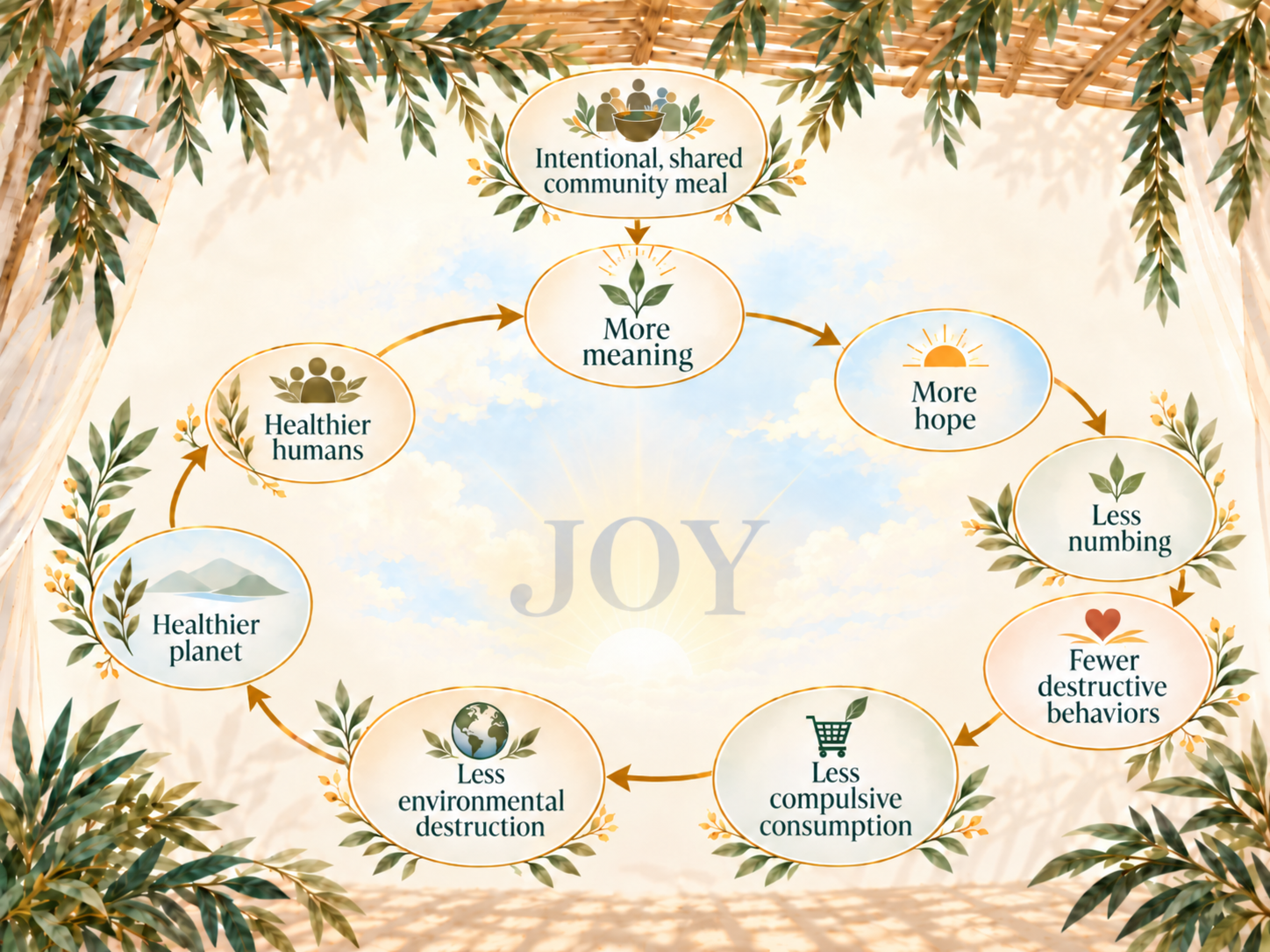
The framework that came to my heart after experiencing Sukkot on Friday
We were invited by one of my favorite women to the home of a couple she has known for decades. My husband and I had never met the couple before, yet when we walked through the front door of their home, we were greeted with hugs, smiles, and joy. We were made to feel like honored guests.
Before long, the whole group made our way outside to their family's sukkah. We learned that for seven days, Jewish people traditionally spend time in this temporary outdoor structure, making it a kind of second home: a place to eat, gather with family and friends, and, in some traditions, even sleep. Its roof, called schach, is made from natural materials such as branches, bamboo, or palm fronds, thatched enough to provide shade but open enough to see the stars. As we understood it, the sukkah recalls the temporary dwellings of the Israelites in the wilderness. For a week, families leave their permanent homes for a simple roof open to the sky, a reminder that the material structures we live in are NOT ultimately the source of our safety. Jewish teachings, we learned, connect the sukkah's impermanence with trust in God’s divine protection.
The symbolism of the sukkah hit home hard for me, no pun intended. Nearly two years ago, my husband and I evacuated from our home in Pacific Palisades and were not able to live there again. The neighborhood was destroyed and became unlivable. Since then, my husband and I have been through another natural disaster that forced us to evacuate our home. Both times, our houses were very fortunately spared. But the experiences have been destabilizing events that have pushed me to question what lesson God is asking me to learn. So I was moved when our host shared that Sukkot is known in Hebrew as Z'man Simchateinu, "the season of our rejoicing." It struck me as a surprising counterpoint to the fragility of the sukkah, but maybe that's the point: if we truly trust that our safety comes from something bigger than ourselves—something timeless and omnipresent—joy becomes possible even in the face of uncertainty.
At the entrance of the sukkah, our host noted a photograph of a young man who had recently been severely injured in a hate crime. Our host asked us to hold this person in our hearts and set an intention for his radical and complete healing. Then we walked inside.
The sukkah walls were covered with photographs, their children's artwork, pictures from the family's sukkahs over the years, images of spiritual figures who had influenced their lives, wedding photos, and family memorabilia. It was like being inside a precious jewel box. Every element was intentionally chosen, meaningful, and filled with love.
As we moved to the dinner table, profound nourishment began before a single bite was taken.
Our host first asked everyone to go around the table and say their name, where they were born, and a song that made them feel like they were soaring. It was such a simple way to make sure everyone knew one another's names and learned something about each person. And instead of asking us to share an achievement or credential, he asked us to share something that made us feel something. It was a question that all fifteen or so people at the table could participate in, whether a young child or an elder.
Candles glowed and the kiddush was said over wine. The host explained that in saying this prayer, we sanctify the time we have together. Time, he noted, is the one thing we cannot make more of, earn more of, or buy back. So there is something profound about intentionally stopping to bless—to make holy—the time we spend together. What could life be like if we chose to make holy each moment of our day?
The parents at the table then blessed their children, standing and whispering blessings into their ears, as we learned is customary on Shabbat. The content, loving looks on the children's faces as they received their blessing made a deep impression on my husband and me. Our host said something powerful after the blessing that stuck with me: if you don't know what to say when you're blessing your child on Shabbat, you are not spending enough time with them. What a potent truth to hear as a new parent.
Then came a ceremonial hand washing—the “lifting up of the hands”—before the challah. We each washed our hands in a specific way and returned to the table without speaking until our host had blessed and broken the challah, drizzled it with honey (which we learned is a custom this time of year, for a sweet new year), passed it around, and we had each taken a bite. The silence, we learned, was intended to create a beautiful connection between the washing, the blessing, and the food. As someone who has talked at length about the sacred relationship between food, our bodies, and the Divine, I cherished this.
Because there were non-Jewish friends there, including us, our host was intentional about assigning people at the table to guide us through the hand washing so we could really be a part of things. They made sure no one felt like an outsider at their table.
A song was sung to honor wives: Eshet Chayil, “Woman of Valor,” from Proverbs 31. There was a line that stuck with me about a woman not fearing the snow because her household was warmly clothed. I heard it as a metaphor for the sacred work of a wife and mother: weaving a family together with enough strength and warmth to withstand the tribulations that inevitably will come. It also praised a woman whose strength comes from her faith rather than her beauty. A stunning message.
Whenever our hostess brought out each course of food, her husband would pause the conversation and ask her to share what she had made. The food was spectacular, and we found ourselves clapping and cheering for her with each unfolding of the meal. The pausing was such a simple way to honor the time and care that goes into preparing a meal, and it made every dish feel more special.
Later in the meal, our host called on me and a couple of other people who were newcomers to their table to share about ourselves with the whole group, so everyone could learn something about our passions and what we cared about. I found myself sharing details and stories I had never shared publicly before, in part because the whole evening felt so heartfelt and safe.
Toward the end of the meal, our host invited his mother, an incredible singer, to sing for the table. She treated us to two songs in Hebrew, and it brought tears to my eyes.
He closed the evening by reading a passage from a book by Holocaust survivor Dr. Edith Eva Eger called The Choice: Embrace the Possible. In the story, Dr. Eger approached a young Jewish man on a plane and chastised him for eating a ham and cheese sandwich, which was not kosher, reminding him that he had made a covenant with God to live a certain way. He told her she was crazy and huffed away. But years later, he found her to tell her that she had changed the course of his life for the better by planting a seed that inspired him to reconnect with Judaism. Our host closed with the pearl from the story: sometimes we need to be a little bold, out there, or even perceived as “crazy” in order to stand up for what we believe is right. And that’s ok.
As we walked to our car, my husband and I had to laugh: we had booked a babysitter for only two and a half hours that night, assuming this Shabbat dinner would be the length of a “normal” dinner, whatever that means in our culture (short, rushed, on to the next thing?). But we happily stayed for almost five hours, sneaking off to the bathroom to text the babysitter for more time, and we were still, reluctantly, the first to leave. This was a dinner with no rush. No tech. No glancing at the clock. Pure presence. The night was slow, intentional, and filled with connection—with God and with one another.
When we got into the car, my husband looked at me and said, “We were in the presence of God tonight.” I nodded in complete agreement. We spent the car ride home discussing all the ways the evening had touched us. We talked about how we felt inspired, seen, welcomed, and connected. What greater gift could hosts give?
“I’ve learned that people will forget what you said, people will forget what you did, but people will never forget how you made them feel.”
We are not Jewish, and we're so grateful to have been welcomed into this evening of tradition. But what strikes me is that so much of what created the deep meaning of the night is available to ANY of us, regardless of belief system. Bringing a community together. Lingering over a long meal. Praying. Expressing gratitude. Singing together. Sharing our stories. Sharing wisdom. Blessing our children out loud. Asking beautiful, open-ended questions of the people around us. A father (or mother) leading a community with wisdom and intention. A mother (or father) nourishing the table with lovingly prepared food. Honoring the people who prepared the food and those who lead the ritual. Putting all technology away. Learning. Bringing generations together. Lighting candles. Dimming the lights. Creating meaning together.
And, our most important learning: Any day, with intention, can be sacred.
🏡 Simple steps to bring more meaning into our own meals and lives
A few ideas, inspired by Shabbat dinner, to help us bring meaning to our own table. None of this requires being religious or evening believing in God:
🙅♀️📱 Put the phones away for the night. Engage in a “digital Sabbath.” It’s just a few hours. Be present.
🌬️ Set intentions out loud for the meal. The intention might be to connect, to make the time sacred, to honor God… whatever is on your heart.
❓️ Open with a question that makes people feel something. Try our host's icebreaker: your name, where you're from, and a song that makes you feel like you're soaring.
🍛 Nourish the soul before the body. A prayer, a round of gratitudes, or even a moment of silence connects the food to something larger.
👪️ Bless your children out loud. Share a few words of blessings for each of your children. What you wish for them, your hopes and dreams for them in that moment, a piece of wisdom you think might really serve them.
🤲 Bless the food. Express gratitude for the various elements of the food and all the miracles that had to conspire for it to be on your plate: the farmers, sunshine, water, air, transportation, drivers, the person who invented an oven, the workers who built it… you get the idea!
👩🍳 Honor the cook. When a dish comes out, stop the conversation, let the person who made it tell its story, and celebrate them. It takes so much work—conceptualizing, shopping, prepping, cooking, place-setting, serving, cleaning—to put a meal on that table for a family or a large group.
❤️🩹 Hold someone in need in your heart. Name a person who needs healing, or ask people to offer the names of people who need extra support, and set an intention for them together.
👭 Make room for newcomers. Invite someone new, and make sure someone is there to welcome and guide them so no one feels left out.
👵👶 Bring the generations together. Invite a grandparent or elder to tell a story or share what they know. Create an icebreaker that the children can take part in without feeling intimidated.
🦉 Close with wisdom. Read a short passage that matters to you: a poem, a quote, a passage from a book, and let it set the tone for people to reflect on after dinner.
🏡 Give people a tour. Take guests around to show them things that are personally meaningful to your family. Let people know you and what lights up your heart.
⏲️ Don't rush. Book the babysitter for longer than you think, so to speak.
🕯️ Light candles, create dim, pleasant ambiance. Make the space feel good, which can happen in ways the are simple and affordable.
You don't have to do all of these. Perhaps, this Friday, pick one or two, and let the ritual grow from there. Are you in?
And feel free to write me back: how do you make your meals sacred?
Dr. Casey

A guide to recent ideas shaping health and human flourishing—and why they matter.
Dr. Casey’s Research Roundup is a Steward-exclusive newsletter series that includes a curated list of important recently published research papers I’ve been reading across metabolic health, nutrition, longevity, environmental health, regenerative agriculture, microbiome science, neuroscience, spirituality, parenting, and emerging technology—along with my reflections on the bigger picture of how it fits in.
The next issue is coming this Thursday, October 8th. Become a Good Energy Steward to gain access and get it straight in your inbox.
Share with a friend: If you enjoyed this issue, please share with a friend! They can sign up for the newsletter here.