Newsletter #70: 🔮 Crystals in your body?
Plus, infradian rhythms and a pesticide scandal
Know someone who might enjoy this newsletter? Share it on social, or copy the link and send it to a friend: https://caseys-means.beehiiv.com/p/newsletter-70
🎧️ Unlock the audio edition of this newsletter, personally read by Dr. Casey, and other offerings by becoming a Good Energy Steward.
Happy Tuesday everyone!
Even after studying the human body for almost 30 years, I still find myself in AWE of how it all works—and desperate to keep learning more. Beyond the sheer astonishment of how the body functions, I’m driven to understand it more deeply so I can be part of working toward systemic changes that create more health in the world, for humans and all life.
In this week’s newsletter, I’m sharing 3 things about health that I’ve found especially interesting lately: liquid crystals in the body, a pesticide scandal in California, and infradian rhythms—and how understanding each might help us better support health on Earth.
Enjoy!
Dr. Casey
PS - I am grateful for your email replies to the newsletter and read all your reflections. Thank you.
1️⃣ LIQUID CRYSTALS 🔮
The body contains crystalline structures — and this knowledge can potentially help us improve our health and change our understanding of healing.
I first learned about liquid crystals in a book called The Book of Stones, one of the ultimate guides to crystals. Crystals are defined as a “solid material whose atoms, molecules, or ions are arranged in an orderly, repeating pattern that extends in all directions.” The book’s introduction talks about DNA as a liquid crystal, which was striking, because as a physician who has studied and worked in genetics for two decades, I’d never thought about DNA as having crystalline properties.
One definition of a liquid crystal is “a liquid whose component particles, atoms or molecules, tend to arrange themselves with a degree of order far exceeding that found in ordinary liquids and approaching that of solid crystals.” Another is that liquid crystals “are in a mesophase (intermediate) between a liquid and a solid…aligned and ordered with the ability to respond to electrical currents or fields of energy.”
So I was delighted when I obtained a copy of Optimize: A Groundbreaking 7-Step Plan to Health and Longevity Through Quantum Biology, Dr. Catherine Clinton's new book. It has an entire chapter on liquid crystals in the body, and explores research suggesting that some biological structures — including cell membranes, DNA, microtubules, and collagen tubules within our skin and fascia — can exhibit these properties: they are ordered, yet able to flow and reorganize. (And just to be clear, the concept of liquid crystals is not fringe – it’s involved in the technology of many screens – LCDs, aka, Liquid Crystal Displays– as well as things as ordinary as laundry detergent).
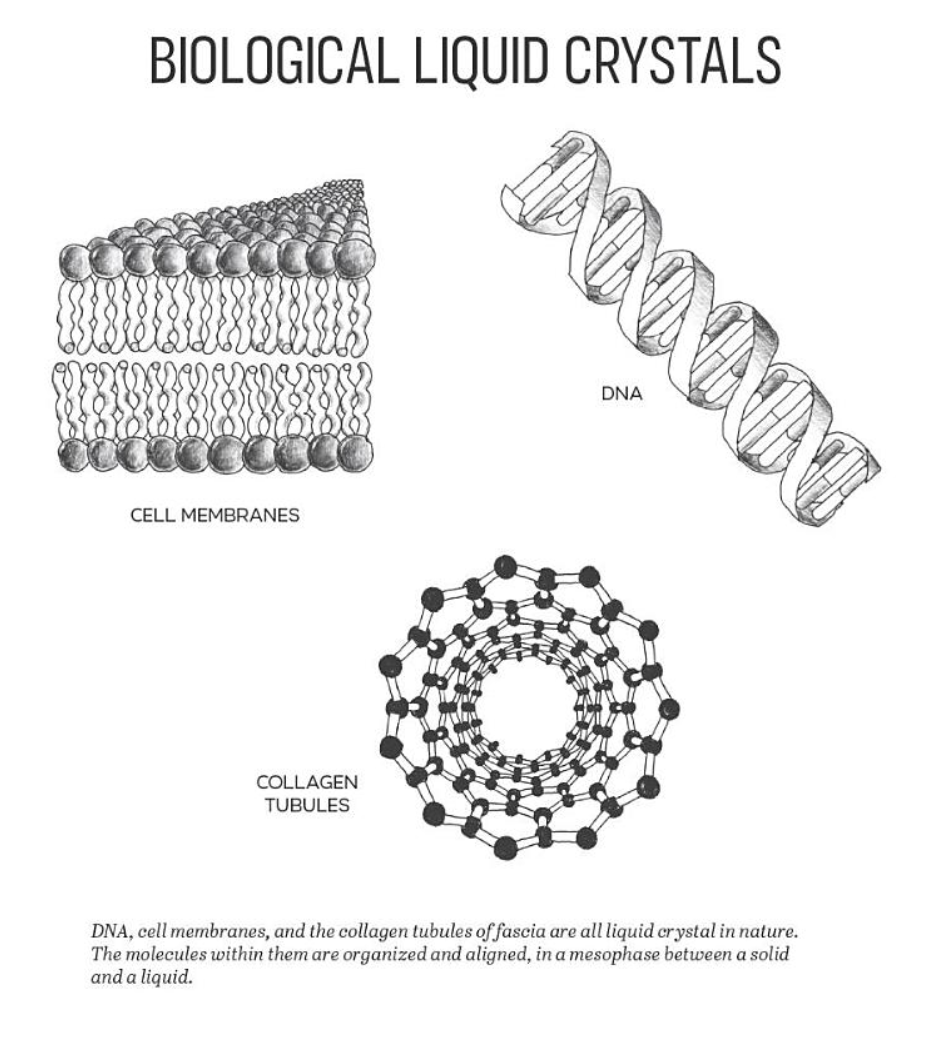
A picture from Dr. Catherine Clinton’s new book which highlights these fascinating, orderly, self-assembling, responsive structures in the body that could be considered liquid crystals.
Thinking about the body as containing crystals could unlock new ways to think about health and healing beyond a standard biochemical framework. By studying the crystalline structures in the body, and how they respond to different factors, we could potentially unlock new ways of healing that harness light, heat, pressure, sound, electricity, and electromagnetism. And, as Dr. Clinton says, “tending to the structures that conduct these forces allows for a much faster form of communication in the body than from chemical signals.” Why? Because “a decrease in the ability to vibrate, to resonate, will impair the ability to transfer information and energy…and this will disrupt the physical, chemical, and electrical environment needed for proper cellular signaling.”
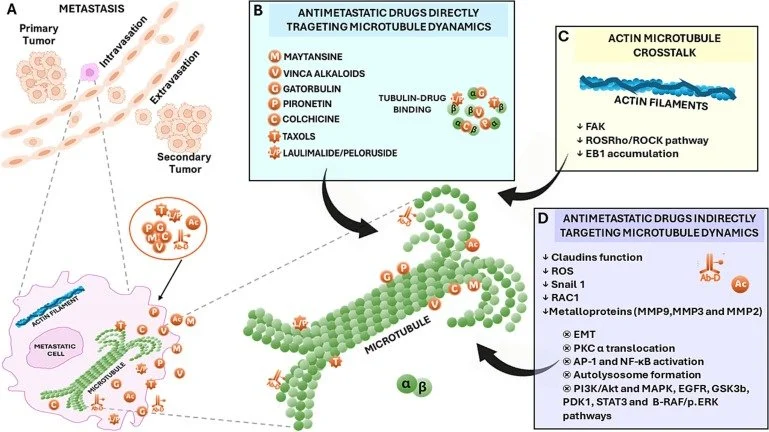
All of this brought me back to a distant memory of a candidate I interviewed for a role at Levels, the company I cofounded, who had a PhD researching cancer drugs that affect microtubule assembly. Microtubules are dynamic protein structures made from tubulin subunits that rapidly assemble and disassemble into precise, orderly hollow tubes inside cells. They help control cell shape, intracellular transport, cellular movement, and—critically—the machinery that separates chromosomes during cell division. Because cancer cells depend on these highly dynamic structures to successfully divide, disrupting microtubule dynamics can arrest cell division and trigger cancer-cell death. Microtubules also help regulate cell migration, making them relevant to the biology of tumor invasion and metastasis. How interesting that by disrupting a dynamic liquid crystal in the body, we can impact cancer.
What does an understanding of liquid crystals in the body mean in practice? From Dr. Clinton’s perspective, we should eat, live, sleep and move in ways that keep the crystalline components of our bodies structurally sound. There are many strategies in the book, but lets zoom in on Dr. Clinton’s recommendations for how to support DNA structure through our exposures and choices:
Eat polyphenol-rich plants → compounds like resveratrol (grapes, berries, peanuts) and quercetin (onions, apples, capers, leafy greens) influence SIRT1, a protein involved in DNA repair and genomic stability.
Eat omega-3-rich seafood → supports healthy inflammatory signaling and has been studied in relation to telomere maintenance, although effects on telomere length are not yet conclusive. (Reminder: telomeres are the “caps” on the end of chromosomes that get shorter with age.)
Reduce exposure to harmful environmental chemicals → pesticides, plasticizers, heavy metals, and endocrine disruptors can contribute to oxidative stress and DNA damage.
Avoid smoking, ultraprocessed food, and alcohol → reduces well-established sources of DNA damage and mutagenic exposure.
Manage chronic stress → chronic stress has been associated with shorter telomeres, while stress-reduction practices may support healthier telomere biology.
Get regular, quality sleep → DNA repair enzymes function according to circadian rhythms, with different levels of activity at different times of day, and impacted by sleep schedule.
Minimize nonnative EMFs, like Wi-Fi, when practical → possible effects on DNA have been proposed, although the mechanisms and human health significance remain uncertain and need more research.
There are several other examples of how our lifestyle choices impact crystal structures in our bodies, like how regular walking and stretching support fascial hydration and function, and how consuming omega-3 fats from sustainably raised seafood like salmon supports cell membrane fluidity and function.
📖 Going deeper:
2️⃣ LADERA RANCH ☣️
Children are getting rare cancers in California, and parents believe pesticides and herbicides are to blame.
In unfortunate recent news, families in Ladera Ranch, California, are demanding an environmental investigation after six local children were reported to have developed Ewing sarcoma, a rare bone and soft-tissue cancer. Wider reporting has identified roughly a dozen children with several types of rare cancer in Ladera Ranch and nearby communities. Families are extremely concerned about pesticides and herbicides sprayed daily in their town being to blame.
Tragically, pesticides and herbicides are routinely used around:
Homes and HOA landscaping
Schools and childcare centers
Parks and playgrounds
Athletic fields
Walking trails and roadsides
And these chemicals are known to cause serious health problems.
Meanwhile, in June 2026, the Supreme Court ruled 7–2 against John Durnell, a longtime Roundup user who developed non-Hodgkin lymphoma and won $1.25 million from a Missouri jury. The Court held that because the EPA approved the label without a cancer warning, federal law barred his state failure-to-warn claim. This verdict was a monumental setback to the momentum amongst families—especially mothers—who want to see more transparency and regulation on pesticides.
The ruling turns EPA label approval into a powerful liability shield for pesticide manufacturers in failure-to-warn cases, even though much of the safety evidence underlying pesticide registration is generated, commissioned, or submitted by the pesticide companies themselves. Here’s the concerning loop: pesticide companies submit safety studies and other data to the EPA; the EPA evaluates that evidence and approves a product label without requiring a cancer warning; and, after Durnell, state courts generally cannot hold the manufacturer liable on the theory that the label should have included that warning.
Problematically, the ruling also narrows an important path for accountability and for bringing new evidence to light. The Monsanto Papers—internal company emails, studies, and strategy documents made public through Roundup litigation that revealed evidence of ghostwriting, efforts to shape scientific research, and interactions with regulators—emerged largely through the discovery process in litigation. By blocking many failure-to-warn cases before they can proceed, the Supreme Court’s ruling could also reduce opportunities for this kind of discovery in future pesticide litigation. This is all very sad and disappointing, and a big win for corporate interests.
💡 Does this interest you?
In the next few weeks, I'm going to be releasing something I've been working on for a long time: a research review of over 75 scientific papers making the case that pesticides are profoundly impacting human health across our lifespan, and practical steps we can take to make a difference. Sign up for the Stewards program to receive this.
Follow Moms Across America to get model letters and local policy resources.
Follow my friend Kelly Ryerson (@glyphosategirl) on Instagram.
3️⃣ INFRADIAN RHYTHMS ⏰
What if women were empowered to embody cyclicality in how they design and live their lives?
I first learned to think about the menstrual cycle as an infradian rhythm through Alisa Vitti's work, particularly her book In the FLO: Unlock Your Hormonal Advantage and Revolutionize Your Life. "Infradian" describes a biological rhythm longer than 24 hours, in contrast to the 24-hour circadian rhythm. Vitti helped bring attention to the reality that women have a second internal clock—the infradian clock—that unfolds across the approximately 28-day menstrual cycle and profoundly shapes energy, appetite, metabolism, mood, and exercise response.
Even though women live by an infradian and circadian rhythm, our culture is squarely built around the circadian clock: we wake in the morning, work during the day, and repeat tomorrow, day after day. It is orderly, linear, and more closely mirrors male hormonals rhythms, which repeat every 24 hours. Men’s testosterone generally peaks in the morning, around 7–10 a.m., then gradually declines throughout the day, reaching its lowest levels in the evening, making the normal American workday work well for male hormonal physiology. Women also live by a circadian clock, but those experiencing a menstrual cycle—roughly 80 million women in the US—are simultaneously moving through a much longer hormonal rhythm that makes each day a little different physiologically, and can have a dramatic impact on daily functioning.
Despite that biological reality, women are largely expected to—and believe they must—work, exercise, care for others, and perform with the same energy every day of the month. This is a recipe for depletion.
I read Vitti's book a couple of years ago and was struck by how ill prepared American women are to navigate their hormonal health, and how empowering it would be if women understood their cycles and lived in accordance with them.
As I've gone through preconception, pregnancy, and the first year of motherhood, I've been thinking more broadly about how profoundly ill prepared it can feel to become a mother in America, where our way of living doesn't facilitate multigenerational knowledge transfer, doesn't meaningfully honor transitions like birth or menopause, and doesn't seem to value the nurturing of life and families as much as direct economic productivity. Women are left fitting decades of life-production and care into the edges of an American life demanding uninterrupted economic productivity.
As I think about how to be a part of a more thriving future, I wonder: What would it look like to help women embody the seasonality and cyclicality built into their biology?
For starters, they might learn cycle literacy early from their mothers and close female mentors.
They might be encouraged throughout their lives to prepare for motherhood—mentally, physically, and spiritually—by building physical health, nutrient reserves, learning practical skills like breastfeeding, attending and witnessing births of loved ones, developing mind-body coping and pain management tools for birth, developing a relationship with a higher power, and investing in strong relationships and community that can support them postpartum.
They might be inspired to architect careers that allow for flexibility and stops-and-starts, and think about creating income through impact and value rather than hours worked. This last one is key, and somehow seems taboo to talk about.
The most practical place to begin is by noticing our own body’s cycles. If you’re a cycling woman, track how you feel across your cycle—energy, appetite, sleep, mood, focus, and desire to move. I pair the Oura Ring with the Natural Cycles app because it makes temperature tracking, recovery, and cycle timing easier to see, and it has profoundly helped me understand my cycle, emotions, and fluctuating needs, and therefore how to ask for support. Another easy way to get in tune with cycles: notice the moon cycle, specifically when there is a new moon and a full moon. At the new moon, think about what you want to cultivate in the next month. At the full moon, think about what you want to let go. (The next new moon is tomorrow, August 12th!). This habit alone helps you become more attuned to the cycles of life. A woman’s cyclical nature should be celebrated and supported: it is the physiology that underpins ALL human life! I think women, families, and communities would thrive more if we thought this way.
💡 Does this interest you?

Dr. Casey’s Research Roundup is a Steward-exclusive newsletter series that includes a curated list of important recently published research papers I’ve been reading across metabolic health, nutrition, longevity, environmental health, regenerative agriculture, microbiome science, neuroscience, spirituality, parenting, and emerging technology—along with my reflections on the bigger picture of how it fits in.
The second issue is coming this Thursday, August 13th. Become a Good Energy Steward to gain access and get it straight in your inbox.
Share with a friend: If you enjoyed this issue, please share with a friend! They can sign up for the newsletter here.