Newsletter #74: 🥛 Creating a brimming life
Lessons from Neruda's September 8th
Know someone who might enjoy this newsletter? Forward this email to a friend, or share the web version here: https://caseys-means.beehiiv.com/p/newsletter-74
🎧️ Unlock the audio edition of this newsletter, personally read by Dr. Casey, and other offerings by becoming a Good Energy Steward.
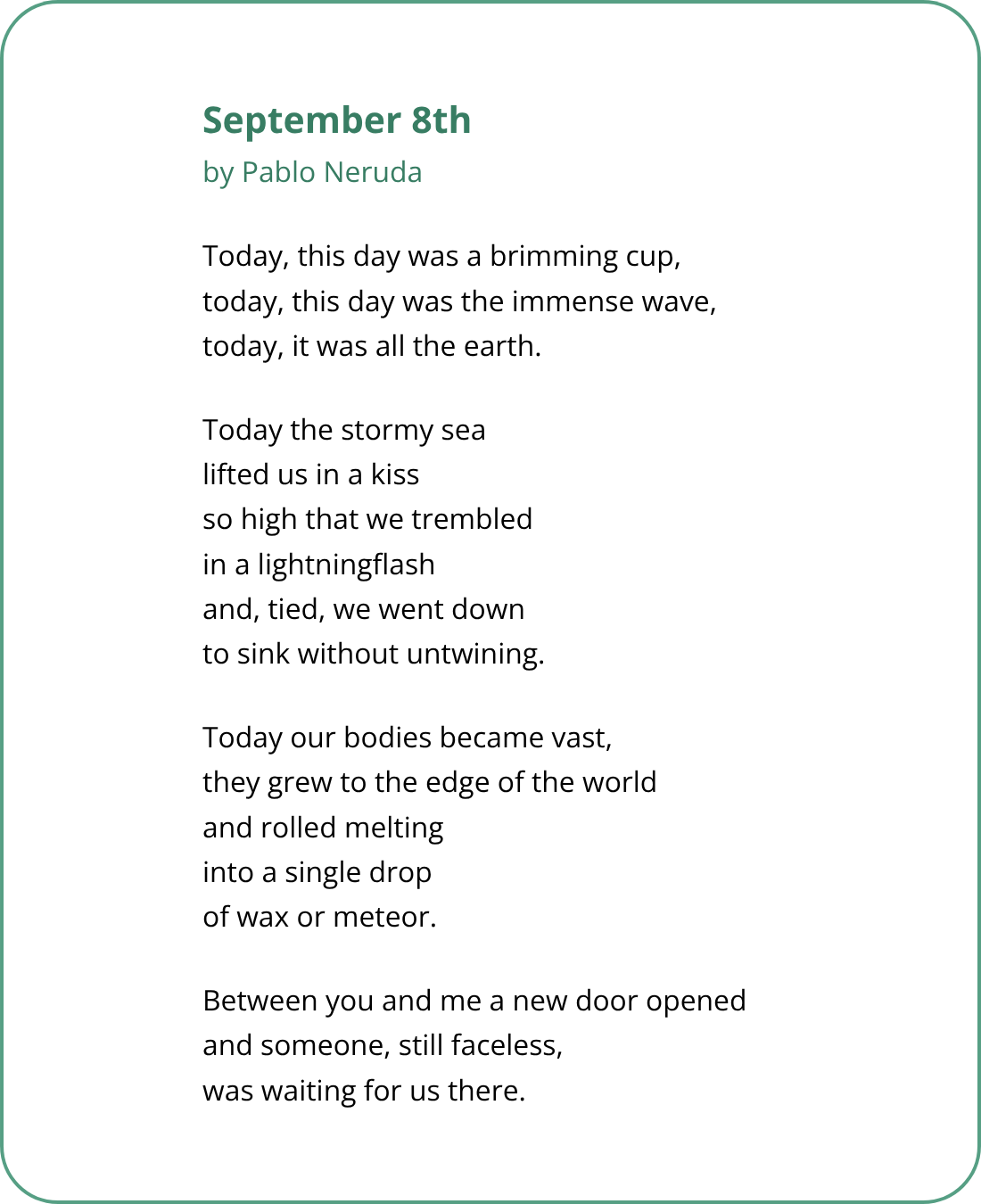
Today is September 8th, so I am thrilled to share with you one of my VERY favorite poems, “September 8th,” by Nobel Prize-winning poet Pablo Neruda. This was one of two poems my husband and I read at our wedding, and it carries a daring message about the stakes required to experience transcendent romantic love.
It’s medicine for our times, when our cultural obsession with control, independence, and reductionism has coincided with high depression rates, low marriage rates, and low birth rates. Let’s dig into what Neruda has to say about living a life literally brimming—overflowing—with love.
❤️ Being present enough to love fully
The poem begins:
Today, this day was a brimming cup,
today, this day was the immense wave,
today, it was all the earth.
Today, today, today: I think Neruda is begging us, for the sake of love, to be in the present moment—an increasing challenge in our digitally saturated, outrage-driven world. To truly be awake to what’s happening in our real lives, not just barreling and scrolling through without looking up. When we’re not present with our lives—constantly looking to the next thing, the next accomplishment, the next milestone, the next Reel—we will miss the monumental beauty happening in our lives today. Slowing down, daily rituals, and intentionally observing our surroundings can help us feel abundant—and abundance is fertile ground for love to bloom.
We don’t want to be the rushing, grasping “hungry ghost,” trapped in a cycle of intense, unquenchable craving. We want to be the person overflowing with SO MUCH LOVE for life that it simply must be shared with another. As poet Kay Ryan writes in another one of my favorite poems, Stardust, to get where we want to go in love a person must “make of yourself a perfect plane / something still / upon which / something settles—” Stillness. Presence. Awareness. A landing spot for love.
Neruda goes on:
Today the stormy sea
lifted us in a kiss
so high that we trembled
in a lightningflash
and, tied, we went down
to sink without untwining.
A stormy sea, trembling, lightning, sinking. So much danger! Neruda highlights that, yes, loving deeply carries profound risk. When we allow ourselves to fully open our hearts and merge with another person, we risk huge loss. Loss of the person we love, loss of independence, loss of complete control. While it may feel safe to keep our hearts somewhat protected and maintain some level of independence, Neruda is telling us that this is no recipe for a brimming love, which requires real risk, and real entwining—needing, trusting, depending on, and being changed by another person.
🪞 The illusion of control
Why are these lines about embracing the “danger” of love important for this moment in time? Because our culture increasingly celebrates control as safety, information as wisdom, and uncertainty as a problem to be solved. And this extends to love. To me, Neruda is saying: this is a way to have a pretty mediocre life.
Before going to a restaurant these days, we can read hundreds of reviews and look at photos of every dish. Before a first date, we can investigate someone’s LinkedIn, Instagram, friends, politics, and years of photographs. We track the people we love on Find My Friends, put AirTags in kids’ shoes, cameras over cribs, GPS trackers on dogs, and devices on our bodies that score how well we slept. (I use several of these technologies, and am not saying they are inherently bad).
COVID made this tradeoff visible at a societal scale: policies purported to reduce the risks of viral transmission created other major risks. School closures and prolonged isolation came with serious costs, including profound learning loss, worsening mental health and domestic violence, social isolation, and increases in childhood obesity. Attempts to eliminate one risk creates—or amplifies—others. We’re seeing the same impulse to eliminate risk in our cultural decisions around parenting, where the idea of control of all aspects of child-raising is becoming more common: a Virginia mother was recently convicted after allowing her 5-year-old to walk about half a mile alone to a nearby pond in their gated neighborhood. At the same time, childhood anxiety has risen dramatically. Could our increasingly risk-averse approach to childhood be part of the picture? 🤔
What my generation might benefit from remembering is that there is no such thing as eliminating risk; there is only exchanging one set of risks for another. And the same is true of love: truly merging our lives and giving ourselves fully to another person carries risk, but so does building a life in which we are closed off from complete honesty, vulnerability, dependence, and the possibility of being fully known. The latter is likely the bigger risk.
My coach Vika asks a question I return to often when I give her some elaborate rational explanation for a strategy I have adopted: “Great, but is that strategy working for you?”
It is a useful question for our culture. The share of American adults who are married has fallen dramatically, prenuptial agreements are increasingly common (47% of engaged or married millennials are managing the risks of marriage by signing one), fewer Americans are having children, and the fertility rate is at a historic low. At the same time, depression rates are rising, particularly among young women. Children and teens are dealing with rampant anxiety. I’m not suggesting that our desire for control explains all of these trends. But taken together, they make me question whether some of the strategies we’ve adopted to protect ourselves from uncertainty or risk are also shielding us from experiences most special about being human.
Neruda then writes:
Today our bodies became vast,
they grew to the edge of the world
and rolled melting
into a single drop
of wax or meteor.
Neruda shows two people becoming less separate and somehow more expansive. They melt together, yet instead of shrinking, they become vast. Surrendering separateness does not diminish them. Partnership creates something larger than either individual could contain alone.
👤 Embracing the faceless person
And then, the most moving visual in the poem:
Between you and me a new door opened
and someone, still faceless,
was waiting for us there.
Through partnership, we have the opportunity to call in the “faceless” person created by the merger of two, opening ourselves to the alchemical mystery of partnership that can help the cup of life overflow. But with our modern instinct to vet, predict, and minimize uncertainty, we’d likely want to assess that “person” before even opening the door. Neruda suggests that the truly surprising, abundant version of our lives requires something else: opening ourselves to transformation. He seems to inspire us to “melt” our lives as we know them—to even metaphorically drown—to allow something new to emerge. Scary? Maybe. Fabulous? Quite possibly.
Home birth and marriage have both taught me that what Neruda says is true for me, even as I still catch myself gripping tightly to control in many areas of my life. The greatest prizes of life often seem to require some surrender of control and courage in the face of uncertainty and mystery.
And ultimately, this question of control is spiritual. If modern culture tells us that safety comes from increasing our own control and surveillance, spiritual life rests on a radically different premise: that our own mind is not the highest intelligence operating in the universe, and our limited perspectives can only get us so far—maybe to the half-full or full cup, but probably not to the brimming cup.
When we make time for prayer, silence, ritual, and reflection, synchronicities become harder to ignore. I write about these all the time. They remind us that reality is larger, stranger, and more interconnected than our rational minds can comprehend. To get from full to brimming, we have to be willing to meet the “faceless person”—to accept, and even seek, mystery, transformation, interdependence, surrender, and the limits of our own control.
Certainly, this doesn’t mean being reckless. Discernment is of paramount importance. Build judgment. Learn about the world through extensive reading, education, exploration, and diverse conversations. Know yourself through self-reflection, writing, and spiritual work. Develop communication skills. Become financially literate. Pay attention to intuition and subtle body sensations. Surround yourself with optimistic, bold people whose decisions you respect and learn from them. Then, when something is truly worthy of trust, don’t treat surrender as weakness.
What I take from this poem, coupled with my own worldview, is this: The most transcendent parts of life seem to require enough discernment to know what is worthy of our trust, and enough courage to surrender once we find it.
💊 Neruda’s prescription?
A few practices I am taking from this poem:
Leave room for the brimming outcome. Make the plan and work hard, but loosen your grip on the exact result. Ask God for the openness to recognize an outcome better than the one you’re imagining.
Create space to receive. Spend time without inputs and pray, walk, journal, or simply listen to the quiet thoughts and sensations coming from within.
Keep track of the “winks.” Write down synchronicities, dreams, animal encounters, intuitive hits, and “Winks from God.” Writing things down changes things for the better, in my experience.
Practice letting trustworthy people lead. Give capable people real responsibility rather than supervising every detail. Allow yourself the opportunity to be truly delighted.
Dr. Casey

A guide to recent ideas shaping health and human flourishing—and why they matter.
Dr. Casey’s Research Roundup is a Steward-exclusive newsletter series that includes a curated list of important recently published research papers I’ve been reading across metabolic health, nutrition, longevity, environmental health, regenerative agriculture, microbiome science, neuroscience, spirituality, parenting, and emerging technology—along with my reflections on the bigger picture of how it fits in.
The next issue is coming this Thursday, September 10th. Become a Good Energy Steward to gain access and get it straight in your inbox.
Share with a friend: If you enjoyed this issue, please share with a friend! They can sign up for the newsletter here.