Newsletter #67: 🌾 What else could be true?
Practicing discernment in an age of outrage

Know someone who might enjoy this newsletter? Copy the link and send it to a friend: https://caseys-means.beehiiv.com/p/newsletter-67
🎧️ Unlock the audio edition of this newsletter, personally read by Dr. Casey, and other offerings by becoming a Good Energy Steward.
“Peace is always beautiful.”
If you've been a reader of my newsletter for a while, you know I love visiting regenerative farms. I love learning from farmers who are on the frontlines of healing our soil, growing and raising the most nutrient-dense, clean food, and supporting a version of our economy that promotes biodiversity rather than extraction—all while cultivating natural beauty.
📖 Read more: Newsletter #48: 🐄 🧑🌾 11 Farms I love that are changing the world
This is a part of our world I can't get enough of. If regenerative agriculture scales, we could have a cleaner environment, a more sustainable and affordable food system, healthier ecosystems, better human health, and stronger communities. Regenerative farming is amongst the winningest of wins.
My husband and I recently visited a regenerative farm where we source our meat. This small farm of about 10 acres raises grass-fed cows, pastured pigs and chickens, rabbits, and goats. They use zero pesticides or chemical inputs, and they tend to the farm as a husband-and-wife duo with the help of a single farmhand. They only ship locally, within about a 200-mile radius, and many of their customers come directly to the farm to pick up meat.
As their operation grew, they expanded onto their neighbor's land for their animals to graze. The land had formerly been used for industrial sweet potato farming, with pesticides applied by the truckload, leaving the soil depleted and dead.
Since bringing animals back onto the land, the rich manure, hoofing, and scratching of the fields have alchemized the soil. The fields are now bursting with life—mostly in the form of head-high guinea grass, a dense invasive grass that serves as one of the main food sources for the cows and pigs on their property.
As I heard the farmer talk admiringly about the guinea grass, I was floored.
Until that day, I had only heard about guinea grass from people in my neighborhood who wanted one thing from it: to completely eradicate it.
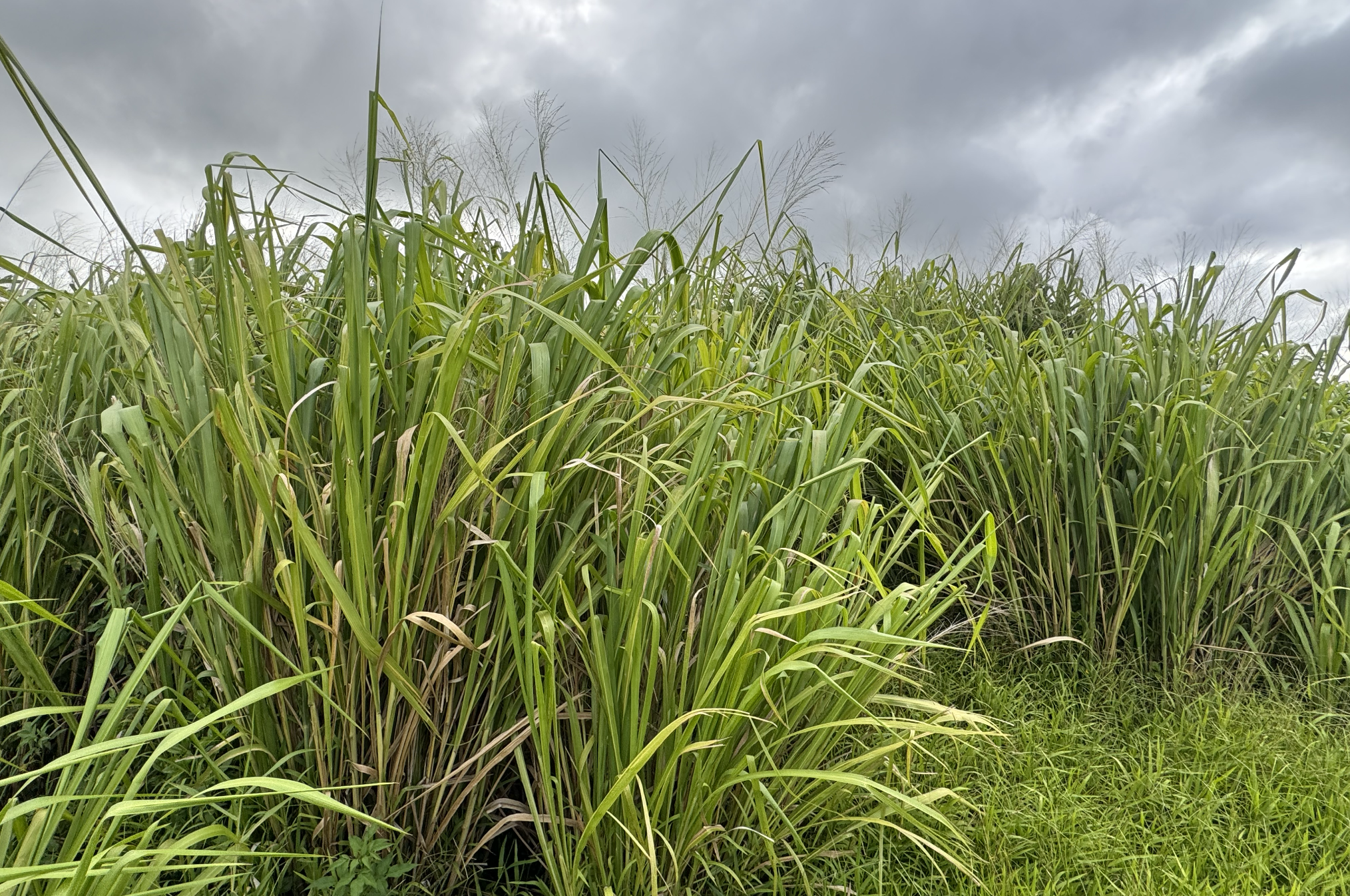
Guinea grass
Guinea grass is considered the ultimate lawn scourge, taking over flower pots, yards, hedges, and native plants. It is a source of endless frustration, expense, and weed-whacking for people trying to maintain a green, pristine lawn.
I had also heard about guinea grass as a safety hazard. The county tries to eradicate it from the sides of roads, where it can grow so tall and dense that it obscures guardrails and visibility. While some areas bring in crews to weed-whack, you will often drive down the road and see stretches of brown, dead grass around the guardrails—a sign that the area has recently been sprayed with an extremely toxic glufosinate-ammonium herbicide called Finale that can cause neurologic and reproductive toxicity, amongst other issues.
This has led to an uproar between local residents who do not want these chemicals sprayed along roadsides, draining into streams and ultimately the ocean, and county officials who say chemical spraying is the only effective option.
What an interesting paradox. Within the course of a single stretch of road, you have:
A farmer to whom the grass represents food for her animals—grass that is transformed into nutrient-dense meat and ultimately becomes the source of income for her family and nourishment for her community.
Homeowners striving for green, pristine lawns who want to eradicate guinea grass for aesthetic reasons.
County officials who see guinea grass as a safety hazard and are using toxic chemicals to eradicate it.
The point here is not that guinea grass is secretly good. It causes real issues, including crowding out native plants and spreading rapidly.
What struck me was realizing that, based on the perspective I had encountered before visiting the farm, I had thought guinea grass was universally a nuisance and universally bad. My mind had never considered that, within a different system and relationship, it could also be useful and valuable. Going out in the world, talking to people, and seeing how they live and work expanded my perspective.
This is the heart of what Byron Katie, author of Loving What Is, teaches. She shares that if there is any other explanation for a situation that could possibly be true, we can and should loosen our grip on the interpretation causing us pain. Suffering often begins when we mistake our first interpretation for reality itself, rather than holding it as one possible story among many.
Loosening our grip on one interpretation does not mean abandoning facts or pretending every perspective has equal merit and morals. It means refusing to confuse a partial truth with the whole truth. And the whole truth is one that, I’d imagine, only God knows.
I think much of the pain in society today comes from our unwillingness to do this. We may see or hear one little thing—a headline, a post, a quote taken out of context, a few seconds of a video—and immediately commit ourselves to certainty, outrage, or even hate. We may decide who is good and who is bad, what is true and what is false, and what an entire person, group, or situation means. Then the dangerous part: we react. We may react outwardly, by writing a comment or email or making major decisions; or inwardly, by deepening the grooves of thought that shape how we experience the world.
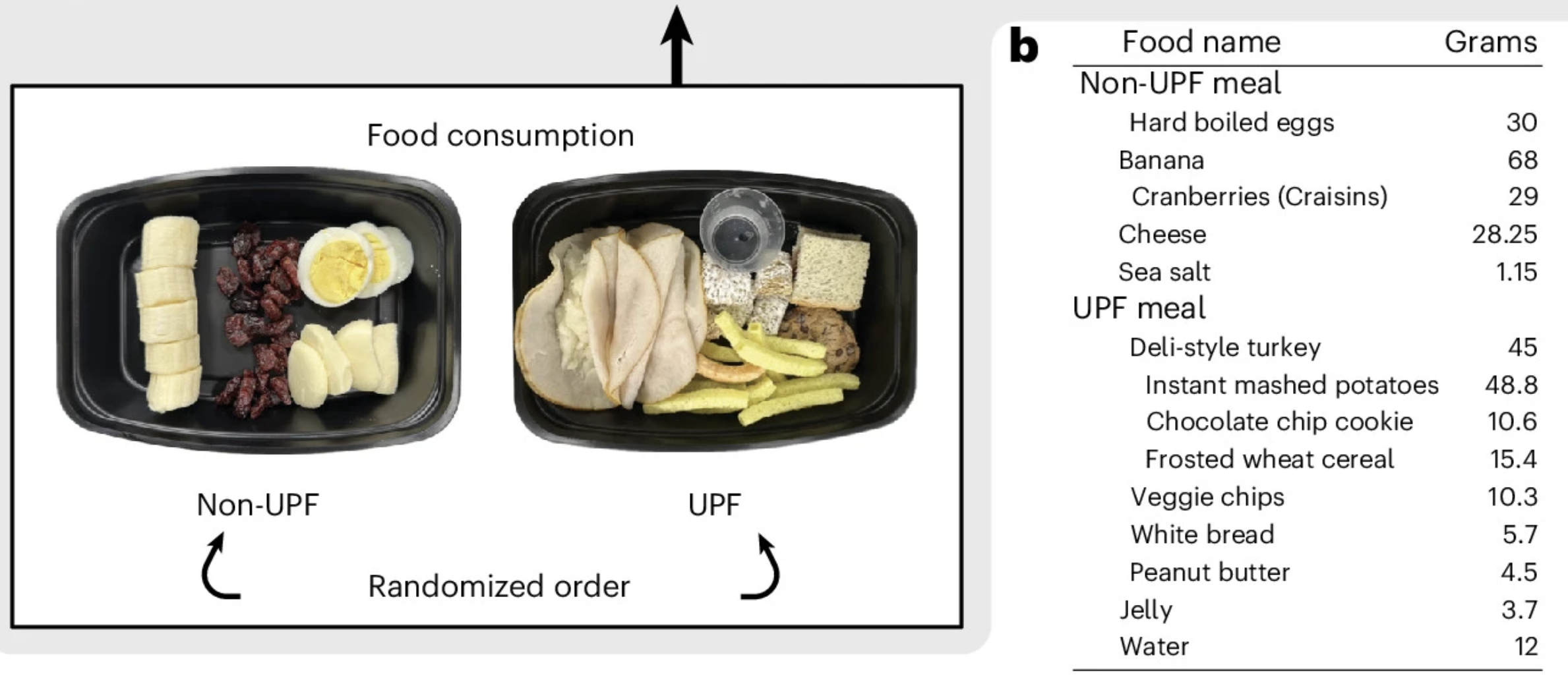
Our information diet has come to resemble our food supply: ultraprocessed, pre-digested, quickly consumable, and engineered to keep us wanting more. And both are making us very sick—in our guts and in our heads. Inflammatory bowel disease, some early-onset GI cancers, irritable bowel syndrome, and GERD are on the rise, as are depression and anxiety. Algorithms now deliver an individualized, inflammatory highlight reel to nearly every human being with a smartphone, cutting deep grooves in our psyches about what is “true” and what is not. Artificially generated images, voices, and videos make it increasingly difficult to know whether what we are seeing is even real. We are reading fewer books, and we are even speaking less to other people.
But there is an opportunity here. As “information” appears more abundant and easier to access than ever, we are being challenged to elevate ourselves and practice discernment: to loosen our grip on the first story we are told and pursue a fuller truth. To seek out multiple perspectives, talk to people with different opinions, ask what context might be missing, read and watch actual primary sources, consider whether any other explanation could possibly be true, and resist committing ourselves to anger before we have made a real attempt to understand.
We are being asked to open our eyes to the real world, engage with real people from different walks of life, have real experiences, read real literature and papers, and then reflect on all of those rich inputs—allowing our thoughts to be emergent rather than prescribed. We are being asked to strive for a deeper state of steady coherence, different from the addictive, easily shareable soundbites of outrage. It sounds hard, but the alternative—which increasingly feels like the direction our civilization is going—is much, much harder.
How do we know if we are practicing discernment? Perhaps we begin by noticing whether our minds are becoming clearer or more inflamed. Whether we are moving toward understanding or simply staying on the merry-go-round of outrage. Whether we are seeking truth, or seeking more evidence for the story we’ve chosen to identify with.
I'd offer a thought experiment for this week: Is there something in your life that you have understood through only one story? A nuisance, an obstacle, a conflict, or a difficult experience. Without denying what is painful about it, is there another perspective that might also be true? Could it become an unexpected input into wisdom, growth, art, strength, inspiration for change-making, or perspective—just as all excrement, properly tended, can be composted into thriving soil?
Difficult experiences need not be passively accepted; sometimes the best response is removal, repair, a boundary, or structural change. But perhaps a different relationship with the challenge can reveal a possibility for productivity we could not see before.
Coming to understand the utility of guinea grass doesn't make it any less invasive. But, it does remind me that the first story is rarely the whole story.
💥 Bonus: 9 Things I’m loving right now
Quick note: Nothing is sponsored, and I have no current financial relationship with anything I mention below 👇️
🦵 Soleus pushups: A SUPER simple, easy way to significantly lower glucose and insulin while sitting! Click the link for the science on soleus pushups; plus, you’ll get a sneak peak of what the daily Good Energy Sparks look like for the Steward community!
🥣 Red Lentil curry for a plant-forward, high fiber dinner (check out a new favorite recipe here by Rainbow Plant Life. Note: I usually start be sautéing onions, carrots, red peppers, zucchini, or other vegetables to give it even more colorful nutrient density and bulk).
🐟️ Seatopia fish (We have it at least 3 nights a week!). My repeat dinner for my husband and I is a big massaged kale salad (sometimes with other greens mixed in like arugula or butter lettuce, after I massage the kale), lots of chopped raw vegetables (tomatoes, red onions, radishes, cucumber, etc), a few sautéed vegetables (like zucchini, mushrooms, eggplant, etc), a bit of chopped kraut, a sprinkle of hemp seeds and/or nutritional yeast, and a dressing made with 1/3 olive oil, 1/3 balsamic vinegar (or mix of different types of vinegars), and 1/3 dijon mustard, plus a teaspoon of honey, all shaken up in a mason jar. I mix all that together in a huge bowl with tongs, then grill up two pieces of regenerative Seatopia salmon in a cast iron skillet and put them on top. Flake salt on top, always. We never get sick of this meal! Seatopia fish is tested for mercury and microplastics, and is raised in a way that supports ocean regeneration.
🗞️ Abigail Shier’s column “Tough Love” in the Free Press: A no-nonsense weekly advice column about love and life that I generally agree with heartily.
🧘 Screen Zen to get off social media. I haven’t used social media in about 14 months, and Screen Zen was really helpful to cut the cord.
😴 My preferred sleep meditation playlist from Spotify: Deep Relaxing Sleep Hypnosis (Sleep in 20 minutes). I have been using this to go back to sleep after my middle of the night breastmilk pumping session and it helps so much!
🥕 Solid Starts: Baby Led Weaning (I love both the book and app!). This is the program we’ve been using to help introduce our baby to solids. It’s really helpful for any new parents out there!
🎧️ The 2 podcasts I listen to every single week:
😋 Favorite dessert of the moment: 1 organic date, small piece Alter Eco Classic Blackout dark chocolate, Nutzo butter, flake salt. YUM.
Become a Good Energy Steward today for just $7.77/month or $77.77/year.
Good Energy Stewards is a membership program, bringing together daily actionable inspiration, gentle accountability, research reviews, art, and monthly opportunities to ask me questions, all intended to cultivate the conditions that turn health information into true embodiment. I share about what led me to start the membership and my philosophy surrounding it, here:Newsletter #63: ✨ Introducing: Good Energy Stewards
Curious about what it feels like inside the community? Here is a glimpse of how our offerings are landing with current Stewards:
💬 Thank you for helping me reclaim my health and wanting to understand how best to live this wonderful gift of life!
💬Today’s spark has inspired me to make the switch! 🥰
💬 I needed this reminder … Thank you for putting this data in front of us to show the reality of the physical benefits.
💬It has taken a great deal of education and lifestyle changes for me to now eat like Dr. Casey Means suggests. … I feel like I walk a narrow path compared to the masses who consume all the conventional holiday fare. So be it!! That's why I'm so thankful for this group of like-minded individuals!
—Stewards’ feedback on the Daily Good Energy Sparks
💬 I love this! 💕 Thank you for reminding me how much I enjoyed learning poetry in college.
💬 I have never really been drawn to poetry, but really loved how you broke it down. It helped it resonate with me. I like how you also talk about how it could have a religious or spiritual or universal meaning making it resonate with all types of beliefs!
💬 I loooved the poem teaching in the email. 😍
—Stewards’ feedback on this month’s issue of Poem of the Month
💬Wow! This was awesome! Thank you so much for answering my question on health anxiety … I also got SO much out of your answers to everyone's questions and really enjoyed learning what's on peoples' minds.
💬I love seeing how many postpartum women are Stewards (I'm three months postpartum with a little girl!). It makes me feel so connected to this community as we are all transitioning into this new role of motherhood together.
—Stewards’ feedback on this month’s Monthly Q&A issue
Join a community committed to health, growth, and positive impact. Become a Steward today for just $7.77/month or $77.77/year.
Share with a friend: If you enjoyed this issue, please share with a friend! They can sign up for the newsletter here.