Newsletter #65: 👟 New study: Exercise regimen linked to 45% lower risk of premature death
A clear guide to the study's exercise targets

🎧️ Want to listen to this newsletter, personally read by Dr. Casey? Become a Good Energy Steward here.
There's a saying, which I will adapt slightly for this newsletter: "People say they would die for their kids—but would they commit to exercising daily for them?"
A new study from Harvard, published in June 2026, tells us that if we want the best chances to be around as long as possible for our kids and families, there is a new threshold we should aim for to reap maximal longevity benefits. This newsletter will unpack the study, offer practical tips for meeting the targets, and hopefully inspire a renewed commitment to our lifelong fitness journeys.
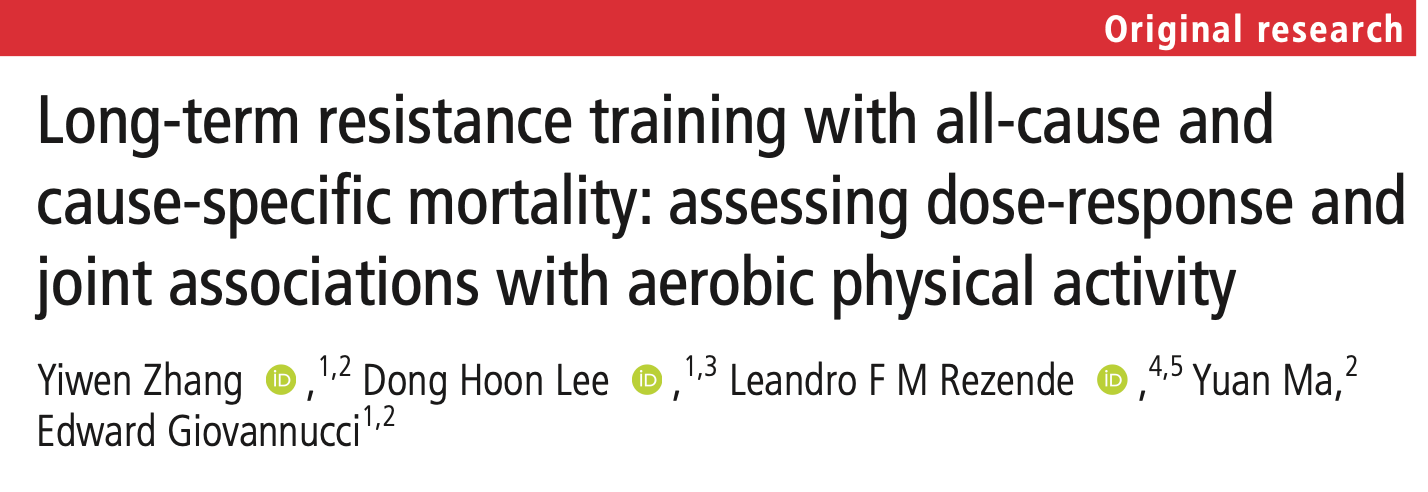
The study, published in British Journal of Sports Medicine last month
My son is 8 months old. Before he was born, my husband and I were up at 6 a.m. many mornings going to brutal F45 workouts. Throughout my pregnancy, we trained three days a week with our incredible friend and trainer, Monica Nelson, right up until three days before labor. Now, between breastfeeding, the baby’s shifting nap schedule, writing, and not wanting to miss time with him, fitting in a workout feels like a huge challenge—and I have yet to find a way to make it consistent. I hit the gym a few times a month for weight machines and the elliptical, do some "mommy and baby" strength workouts on YouTube, and we walk a lot as a family. But it's too inconsistent for optimal fitness, and I can feel it.
Fortunately, a new study from Harvard was the honest kick in the butt I needed, and maybe it will be for you, too! It reminded me why this all matters—and I think it's incredibly important to share. I want to be strong for decades to come: for my family, myself, the wider community, and as a way to honor God for the precious gift of life. This paper shows us one of the most powerful ways to do all that.
Quick gut check: Do you think you exercise enough?
Most of us simply don’t. Not even close. One 2016 study found that people overestimated the amount of moderate and vigorous exercise they got by about 40 minutes per day (!) while underestimating their sedentary time by more than two hours per day. Even if you're among the just 22% of Americans who meet the CDC's basic physical activity guidelines (150 minutes of moderate or 75 minutes of vigorous exercise per week, plus two strength-training sessions), this new study suggests that those guidelines are a floor, not a target. People who consider themselves "active enough" by CDC standards may still be leaving big benefits on the table. This is one reason the United States has some of the highest chronic disease rates in the world, despite advanced healthcare. We simply don’t move enough, yet many of us think we do.
Here's exactly what the study found, what it means in real numbers for your actual life, and how to track it all seamlessly.
🏃 Quick summary of the study
Researchers pooled data from three of the longest-running health studies in the world — the Nurses' Health Study, Nurses' Health Study II, and the Health Professionals Follow-up Study — covering 147,374 people followed for up to three decades. Every two years, participants reported how much time they spent on:
Aerobic activities: brisk walking, running, jogging, swimming, cycling, tennis, squash, strenuous outdoor work, and stair climbing
Strength training (aka, resistance training): weight machines, free weights, or bodyweight moves like push-ups, squats, and lunges
Because activity was measured repeatedly over decades rather than just once at the start (the flaw in a lot of older research), and because the study tracked actual deaths — not just self-reported health — this is a strong observational exercise study.
🔑 Over 30 years of follow-up, participants who consistently combined 30–45 weekly MET-hours of aerobic activity—which is roughly equivalent to 4–6 hours of jogging or 8–11 hours of brisk walking per week—with 60–119 minutes of strength training each week had a 45% lower risk of death from any cause than those who did inadequate aerobic activity (<7.5 MET-hours/week) and no strength training.
Most Americans aren't getting close to this level of activity, and this study gives us a clear, evidence-based target to work toward: a specific weekly dose of aerobic activity paired with regular strength training, sustained over the long haul.
😅 What is a MET-hour? (You'll need this to understand everything below, and it’s VERY useful)
A MET (metabolic equivalent of task) is a way of measuring how hard an activity makes your body work compared to sitting still.
Sitting = 1 MET.
The harder the activity, the higher the number:
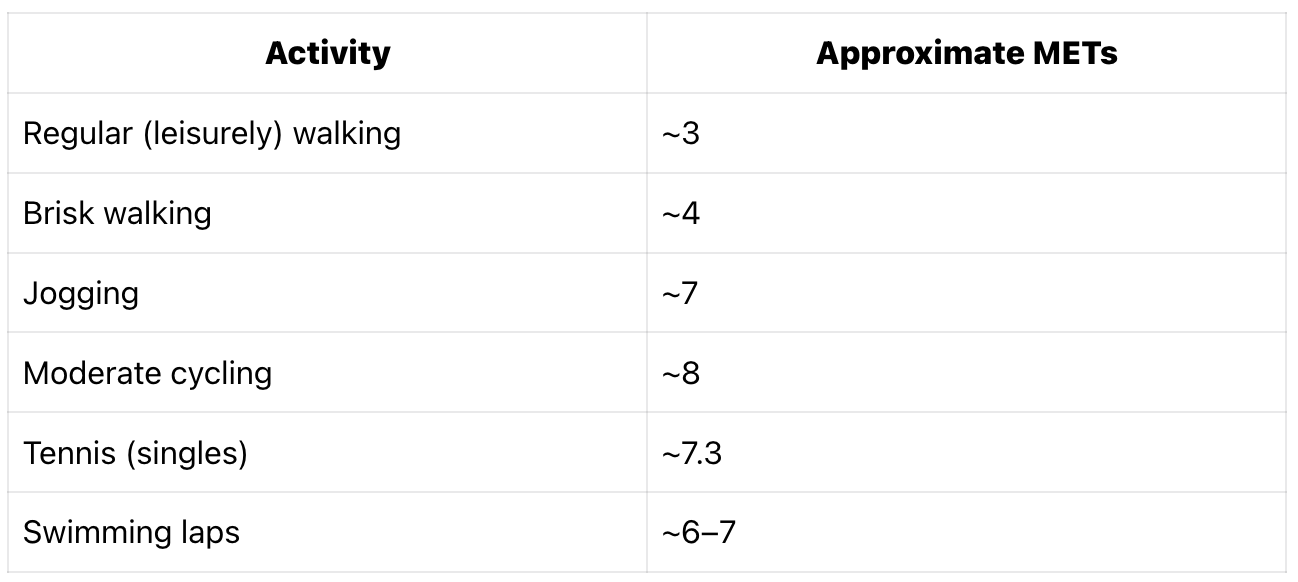
(These figures come from the 2024 Adult Compendium of Physical Activities — the standardized, research-grade reference researchers and public health agencies use to assign MET values to real-world activities. It’s fun to poke through! And remember, no matter what the number says in there, only YOU know how hard you are working… if a specific activity is fairly easy, it's likely low METs; if you’re working super hard, it’s likely high.)
A MET-hour just multiplies intensity × time.
Jog for one hour at 7 METs, and you've banked 7 MET-hours. Walk leisurely for one hour at 3 METs, and you've banked 3 MET-hours. Sprint for an hour, and it's a whopping 13+ MET-hours.
🔍️ What the study found
🏋️♂️ Resistance training alone
Compared with no resistance training, after adjusting for aerobic activity, people who did 90–119 minutes of strength training per week had:
13% lower risk of dying from any cause
19% lower risk of dying from cardiovascular disease
27% lower risk of dying from a neurological disease (including dementia)
Benefits plateaued at 120 minutes/week — doing more strength training than that didn't add further protection.
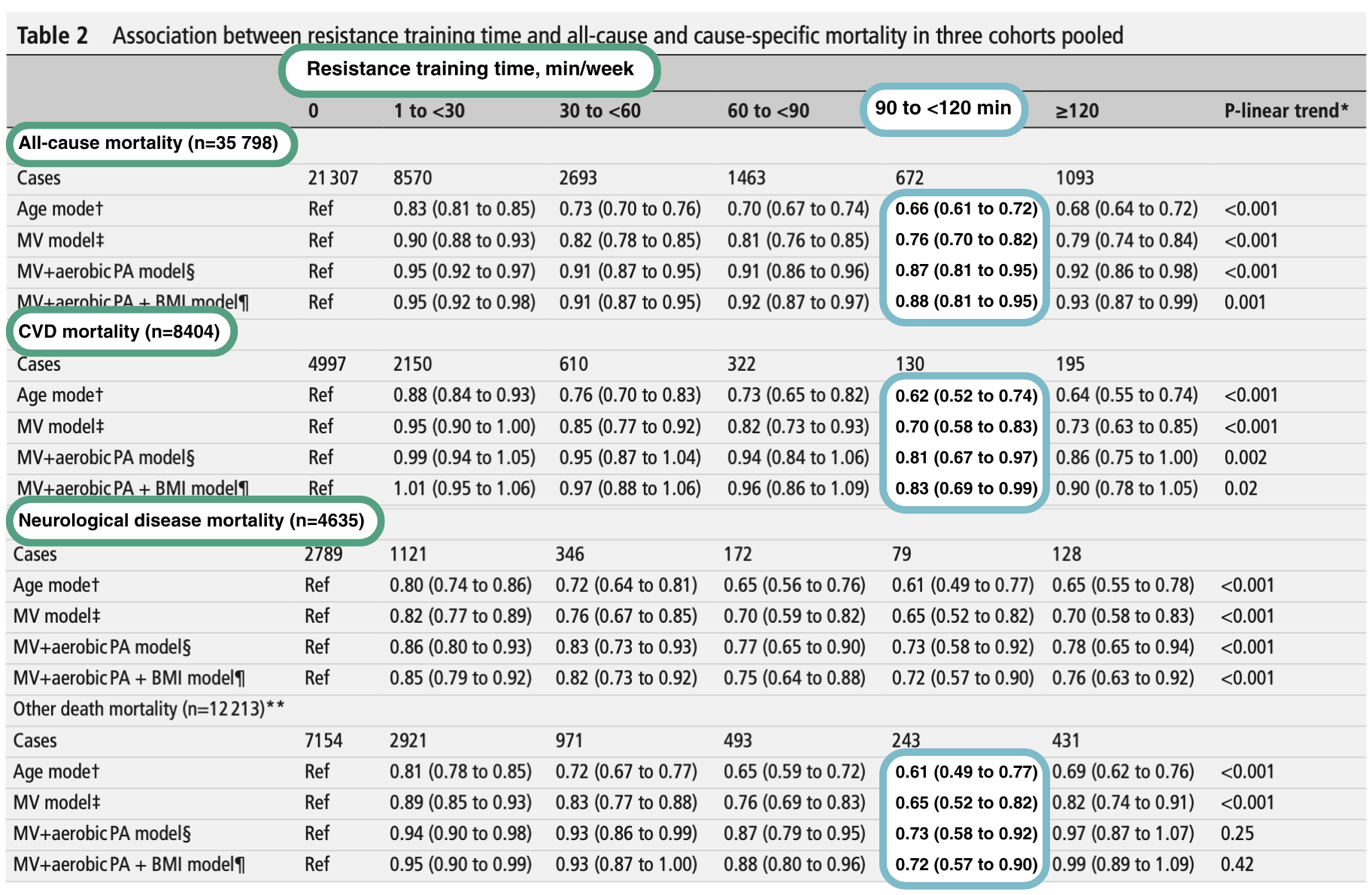
Table 2 looks at hazard ratios, meaning the risk of an event (here, death) between two groups over time — an HR of 0.87, for instance means that group's risk of death was 87% of the reference group's risk, or 13% lower. For all-cause mortality, cardiovascular disease mortality (i.e., heart disease and stroke deaths), and neurological disease mortality, the risk of death was most reduced when individuals did 90 to <120 min of strength training per week.
🏃♀️ Aerobic activity alone
This is where the numbers get bigger. Compared to people below the guideline minimum (under 7.5 MET-hours/week, which is equivalent to about one single hour of jogging per week) and doing no strength training, any amount of aerobic activity above 7.5 MET-hours/week was linked to 26–43% lower risk of death, with the benefit climbing the more activity people did.
🏋️ + 🏃 Strength and aerobic combined — where it gets incredible
This is the finding that makes me feel REALLY motivated to get back into a consistent fitness routine for the long haul:
In people with low aerobic activity, adding resistance training was associated with a smaller mortality reduction: 7% mortality reduction for 1–59 minutes of resistance training per week, and an estimated 11% mortality reduction for 60–119 minutes of resistance training per week, though the latter estimate was less precise. So, if you’re fairly sedentary, adding resistance training can give a moderate reduction in risk.
People with high aerobic activity (30–45 MET-hours/week) plus 60–119 minutes of strength training had a 45% lower risk of death — one of the lowest-risk combinations the study measured.
People hitting 45+ MET-hours/week of aerobic activity saw a 42–47% lower risk of death — regardless of how much strength training they did. At this level, aerobic volume alone seemed to carry the load.
In other words: Pretty high aerobic activity plus an hour to two hours per week of resistance training slashed risk of dying during the follow-up period of this study by almost 50%. And once you get your aerobic volume high enough (45+ MET-hours/week), strength training's added benefit levels off — but getting to that level of aerobic activity in the first place is where most of the life-extending signal lives.
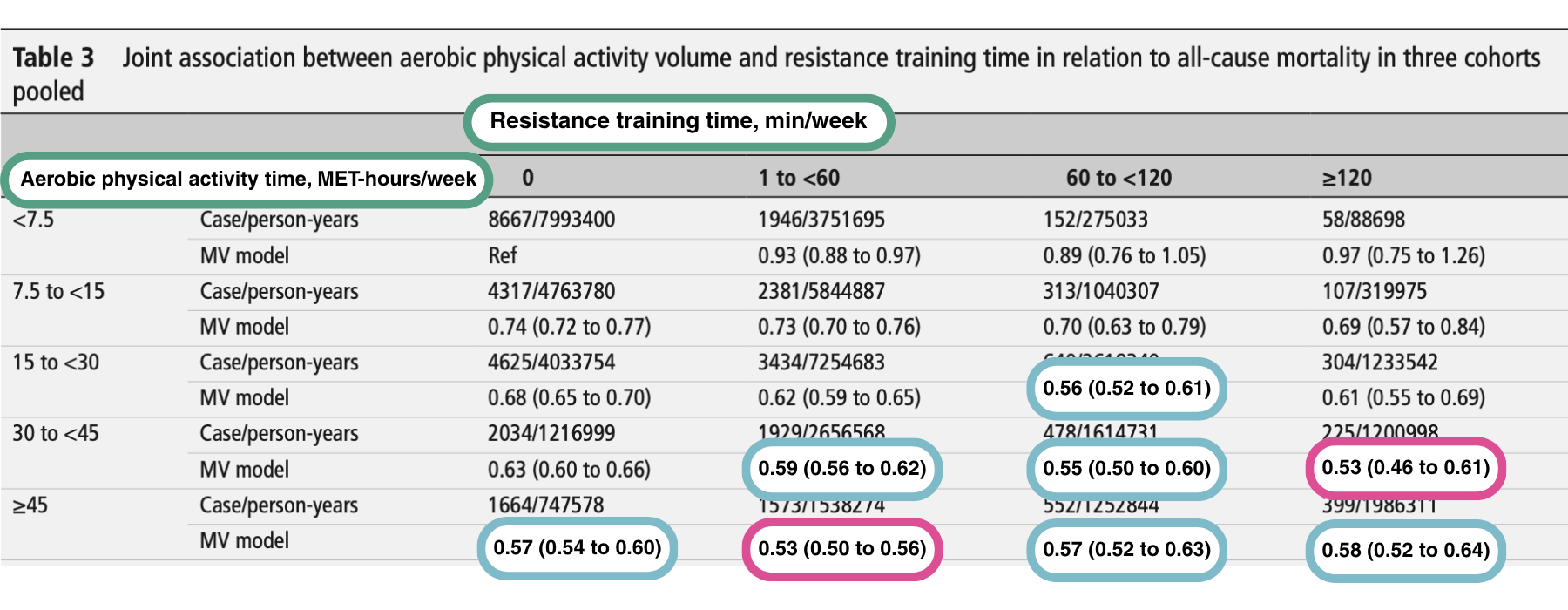
In Table 3, I’ve circled all the conditions that led to the most significant reduction in risk of death from all-cause mortality, with pink circles being the strongest mortality reduction. This includes: 1) Bottom row: The groups doing ≥45 MET-hours per week of aerobic activity, at all strength training levels; 2) Second to bottom row: The groups doing 30 to <45 MET-hours per week who also did any non-zero amount of resistance training (1–<60, 60–<120, or ≥120 min/week); and 3) Third row: People doing 15 to <30 MET-hours per week who also did 60 to <120 minutes of resistance training per week. The strongest mortality reduction (HR 0.53, pink circles) was shared by two groups: those doing ≥45 MET-hours/week of aerobic activity with only 1–<60 minutes of strength training, and those doing 30–<45 MET-hours/week with ≥120 minutes of strength training.
Cool, so how many hours per week do I actually need to commit to get to these levels?
Here's the reassuring part: hitting 35 MET-hours of aerobic activity (comfortably inside the study's 30–45 "sweet spot") plus 60–119 minutes of strength training doesn't require non-stop working out.
Depending on the activity — cycling gets you to 35 MET-hours in around 4.4 hours a week, jogging in around 5 hours, a moderate-pace elliptical in closer to 7 hours — adding the strength training range on top brings the total weekly workout time to somewhere around 6 to 8 hours, or roughly a little over an hour a day, 5–6 days a week. That's the whole ask. The number isn't the hard part — showing up for it week after week, for years, is. Consistency, not intensity, is what actually separates the people who get this benefit from the people who don't.
Here's what different weekly MET-hour aerobic targets actually look like in real life:
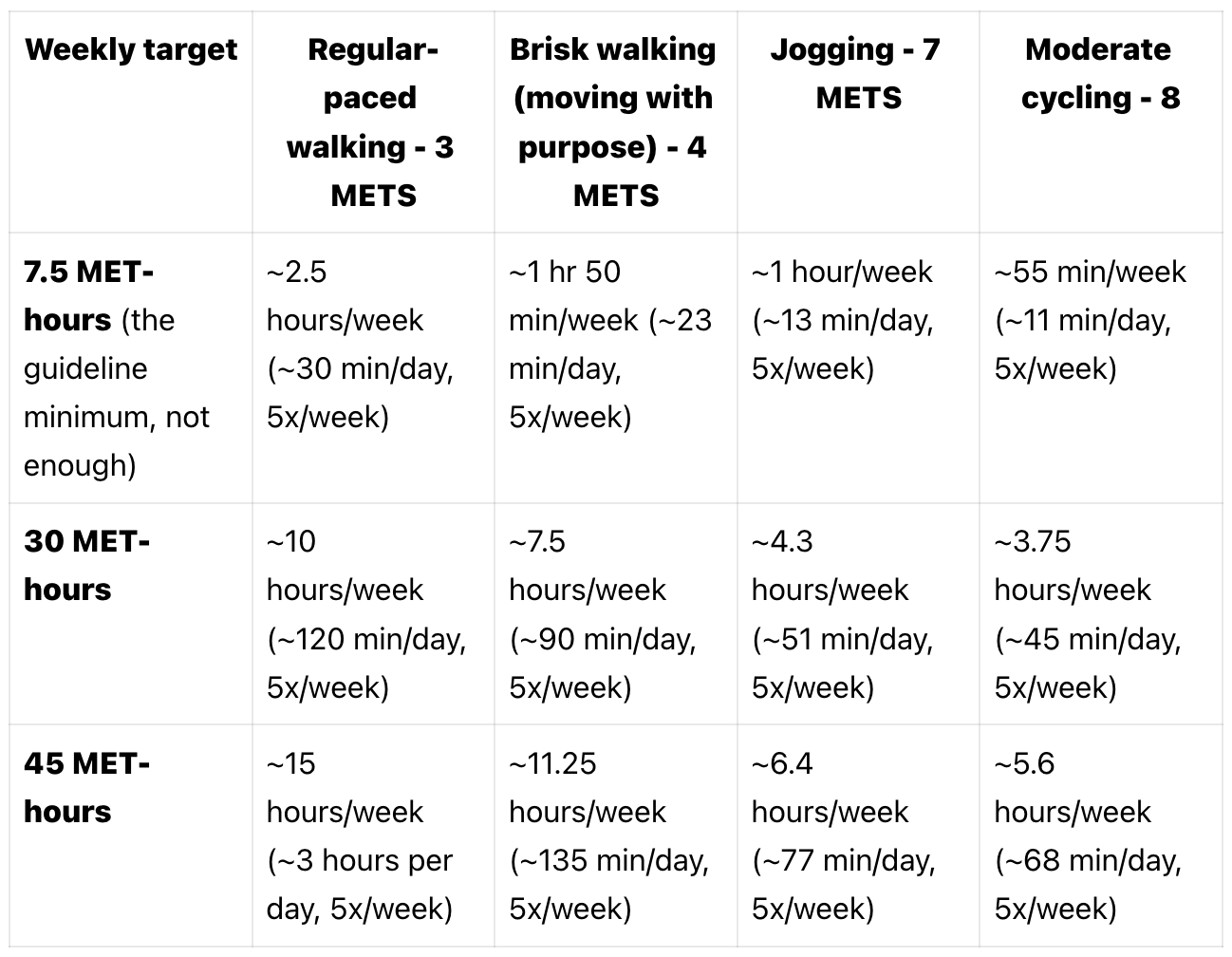
If you consider walking your exercise, this table is a reality check. A casual-to-regular walk may be around 2.5–3 METs, while brisk walking is closer to 4 METs — so walking counts, but it takes more total time to accumulate high MET-hours. To reach the 45 MET-hour mark linked to the biggest mortality benefits in this study through regular-paced walking alone, you'd need to walk roughly 15 hours a week — about 3 hours a day, 5 days a week. That may not be a realistic plan for some people, which is exactly why the table also shows brisk walking, jogging, and cycling: picking up the pace (or picking a more intense activity) dramatically cuts the time investment needed to actually get the benefit, because you get more METs per hour.
A more realistic mixed week that lands you around 38 MET-hours (right in the study's top-benefit zone) might look like:
3× 45-minute brisk walks → 9 MET-hours
2× 30-minute jogs → 7 MET-hours
1× 60-minute cycling session → 8 MET-hours
2× 60-minute tennis matches → ~14.6 MET-hours
Total: ~38.6 MET-hours
That's active — but not extreme. No single session is brutal. It's just consistent, varied movement spread across most days of the week.
⚕️ How this compares to what the CDC currently tells us to do
The current CDC guidelines are a floor; in this study’s cohort, the lowest mortality risk was seen at several multiples above the CDC’s minimum. The current CDC Physical Activity Guidelines for Adults – which only 22-25% of Americans meet, recommend:
150–300 minutes/week of moderate aerobic activity, OR 75–150 minutes/week of vigorous activity (roughly 7.5–15 MET-hours/week, per the study's own framing)
2 or more days/week of muscle-strengthening activity
The CDC defines moderate intensity as 3.0 to 5.9 METs and vigorous intensity as 6.0+ METs. So, per the CDC’s definition, brisk walking (4 METs) is moderate, and jogging (7 METs) is vigorous.
The study used the CDC guideline minimum (7.5 MET-hours/week) as the cutoff for its lowest aerobic activity category. The lowest-mortality group in this study was doing 4 to 6 times that weekly aerobic volume (30–45+ MET-hours/week).
To put it simply: technically meeting the CDC guideline is enough to get some benefit — but the people getting the biggest survival advantage in this Harvard study were exercising several multiples beyond what the CDC’s official guidelines currently asks of us.
The good news is that every additional MET-hour you add, up to around 45 MET-hours/week, appears to keep buying you more protection. There's a lot of room to improve for many of us, and the study suggests that room is worth investing in. And, the more intensity of work you put in (i.e., jogging versus walking), you rack up more MET-hours in a shorter amount of time!
❔ The honest questions to ask ourselves
Ask yourself honestly, and answer yes or no:
Am I part of the 22% of Americans who meet the bare minimum CDC guidelines — at least 150 minutes of moderate aerobic activity (or 75 minutes of vigorous activity) per week, plus two strength training sessions? Or am I part of the 78% who aren't?
Do I know how many MET-hours I actually get in a typical week?
Am I doing any structured strength training at all — and is it in the 60–120 min/week sweet spot?
Am I doing these levels of activity consistently — week after week, year after year?
If I'm not there yet — is it a time problem, an energy problem, or just never having made a real plan?
What’s one thing I can do today to move toward these goals?
📱 A simple way to actually figure out how many MET-hours you are doing: ask Claude or ChatGPT
Here’s a simple way to get a sense of whether you’re meeting the activity thresholds based on this paper: describe your week in plain language to Claude or ChatGPT, and ask it to convert your activities into a MET-hours summary.
Try a prompt like this:
"Here's what my exercise looked like this week: [describe each activity, how long, and how intense it felt — e.g., 'Monday: 30-minute stroll with the dog. Wednesday: 45-minute gym session, mostly weights — squats, bench press, rows, pushed myself hard but not to failure. Friday: 5k jog, about 28 minutes. Saturday: 90 minutes of casual tennis with a friend.'] Based on standard MET values, estimate my total aerobic MET-hours for the week and my total strength training minutes. Then tell me how that compares to: (1) the CDC's minimum guideline of ~7.5–15 aerobic MET-hours/week plus 2+ days of strength training, and (2) the higher 30–45+ MET-hour range linked to the biggest mortality risk reduction in the 2026 Harvard resistance training study (Zhang et al., British Journal of Sports Medicine)."
Do this weekly, and you'll have a useful trend line on where you land relative to both the minimum guideline and the range this new research suggests really moves the needle.
Practical ways to actually hit these numbers
A few ideas to transform knowledge into action:
🖥️ If you’re a desk worker — don't just sit for all those Zoom calls and emails! Put a stationary bike or walking pad in front of the computer and get your MET-hours in while you work. Two hours of walking slowly while working is two hours of cycling or walking you'd otherwise have to find time for elsewhere. (Walking pads are as low as $100 on Amazon.) If this isn’t possible, try taking a 2 minute movement break every half hour — a short walk or a few air squats work great.
🏆️ If you’re really into the World Cup — same as above! Power walk while you’re watching the games on a walking pad, or listen to the game while you workout. ⚽️
👶 If you're busy with a young kid — swap the stroller walk for a jogging stroller and do a light jog. Same time out of the house, dramatically more MET-hours.
🏋️ If you're a busy parent trying to fit in strength training — a bodyweight circuit (squats, lunges, push-ups) during nap time, or a few free weights you keep in a common room you can lift while your child plays. 60–120 minutes/week can be built from several short sessions.
🗓️ Put it on the calendar! Don't leave 30–45 MET-hours of aerobic activity and 60–120 minutes of strength training to chance during the week — block the actual times on your calendar the same way you'd block a work meeting, and write how many METs you aim to do. What gets scheduled gets done, and these minutes are far more impactful than most meetings. One hour a day, 45% lower risk of premature death… This. Is. Worth it.
📌 Put your "why" somewhere you'll actually see it. A sticky note on the mirror, a photo on the fridge, a note taped by your desk — whatever your real reason is (your kids or partner, your health, a milestone you want to be around for), keep it visible.
📔 For more motivation, check out my dear friend Dr. Gabrielle Lyon’s books: Forever Strong: A New, Science-Based Strategy for Aging Well and The Forever Strong Playbook.
🧐 A few caveats about this research
This is observational data, not a randomized trial — it shows strong associations, not guaranteed cause-and-effect, though the repeated 30-year measurements make it more convincing than most studies of its kind.
The population studied was mostly Caucasian health professionals (nurses and other health workers), so results may not be fully generalizable, but they are directionally interesting.
This study examines exercise volume and broad activity categories—not exercise programming—so it doesn't address important variables like intensity distribution, VO₂ max, exercise sequencing, or the optimal modes and doses of resistance training.
Activity was self-reported, though validated questionnaires and averaging repeated reports over time likely reduced errors compared to studies using a single baseline measurement.
Cancer mortality showed an unusual pattern: only lower levels of strength training (1–59 min/week) were linked to reduced cancer death risk — more wasn't better there, and the reason isn't fully understood.
None of that erases the core takeaway: more movement—especially combining aerobic exercise with strength training—tracked with meaningfully lower mortality risk, and is another piece of strong data that we need to be moving (and lifting) much more.
💪 Let’s be strong together,
Dr. Casey

Stay up-to-date on the very latest research shaping our understanding of human health, food, and the environment! The first issue of Dr. Casey's Metabolic Research Roundup is all about the microbiome, written in an easily digestible format 😉 . Read it this Thursday, July 9th, 2026, as a Good Energy Steward. Click here to become a member.
Forward to a friend: If you enjoyed this issue, please forward to a friend! They can sign up for the newsletter here.