Newsletter #61: 🙏 Gratitude: A superpower for an inconceivable future
(Plus, it's great for metabolic health)
After experiencing a wildfire that burned down my neighborhood, becoming the Presidential nominee for Surgeon General (and having the nomination withdrawn), and being pregnant and giving birth at home, I’ve spent a lot of time over the past year contemplating the limits of prediction and control — and how to foster resilience in the face of uncertainty.
These experiences led me to more intensely embrace surrender, community, and prayer as powerful tools for navigating forces bigger than ourselves.
In that context, my husband and I recently watched the ominous movie The AI Doc: Or How I Became an Apocaloptimist. While it’s an artfully crafted documentary—full of hand-painted animations and interviews with some of the top AI researchers and CEOs in the world—it launched me into an anxious spiral about the future and fears I didn’t even know I was supposed to have. (Total human extinction within the next decade? What?!).
In this moment of AI-nxiety, the tools of surrender, community, and prayer didn’t feel very accessible. But a series of interwoven experiences that unfolded around this time helped me regain my footing and may serve as a model for transmuting periods of struggle — and that’s what I want to share in today’s newsletter.
😉 “Winks from God” highlight the answers we need
It’s hard to conceive of what the future will hold as it pertains to AI. In fact, if Artificial General Intelligence (AGI) or technological superintelligence emerges, a fear is that humans may not even be able to literally comprehend what comes next, since the technology may become far smarter than us, capable of implementing plans beyond that which we can cognitively conceive.
One recent morning, I found myself sitting outside with my son in soft morning sunlight, staring out at beautiful trees and mountains, drinking delicious coffee, and feeling light-years away from a future in which an AI takeover of the human species might occur. I turned on the latest podcast by Cathy Heller, a Kabbalah teacher and friend whose podcast, Everything is Energy, always leaves me feeling more hopeful and connected. I was delighted to find that the episode featured Dr. Lisa Miller, founder of the Spirituality Mind Body Institute at Columbia University and the leading researcher on the (very real, very evidence-based) neuroscience of spirituality.
Dr. Miller’s research in her book The Awakened Brain combines epidemiology, clinical psychology, genetics, and brain imaging to show that humans are
—and that an active spiritual life is associated with lower rates of depression, substance abuse, and suicidality, along with greater physical health and wellbeing across the lifespan.
Deep into the conversation, Cathy and Dr. Miller started talking about AI and epiphanies—the lightning bolts of inspiration that arrive seemingly out of nowhere.
Cathy said:
“We all have built into our brain the antenna through which to receive a vision that’s never been handed to us before... I don’t think for an instant that AI could replace human imagination because as a piece of the Master, the human receives sacred consciousness… a human can raise the antenna and receive an idea that has never, ever before been envisioned. It’s not the additive sum of one hundred other good ideas... It is a quantum leap. And that is divine.”
I loved this message – the idea that a differentiator between human intelligence and AI intelligence is that human intelligence has the (inconceivably powerful) competitive advantage of receiving insights from God. I wanted to write the passage in my journal, so for the first time ever, I opened Spotify and looked at the transcript of the podcast episode. As I scrolled to the passage I wanted to copy, I noticed a typo in the middle of the passage. Instead of the transcript accurately conveying, “It’s not the additive sum of one hundred other good ideas,” the transcript read:
“It’s not the additive Psalm of 100 other good ideas.”
This stopped me in my tracks. I am always interested in subtle occurrences that feel beyond coincidence, so I had to look Psalm 100 up:
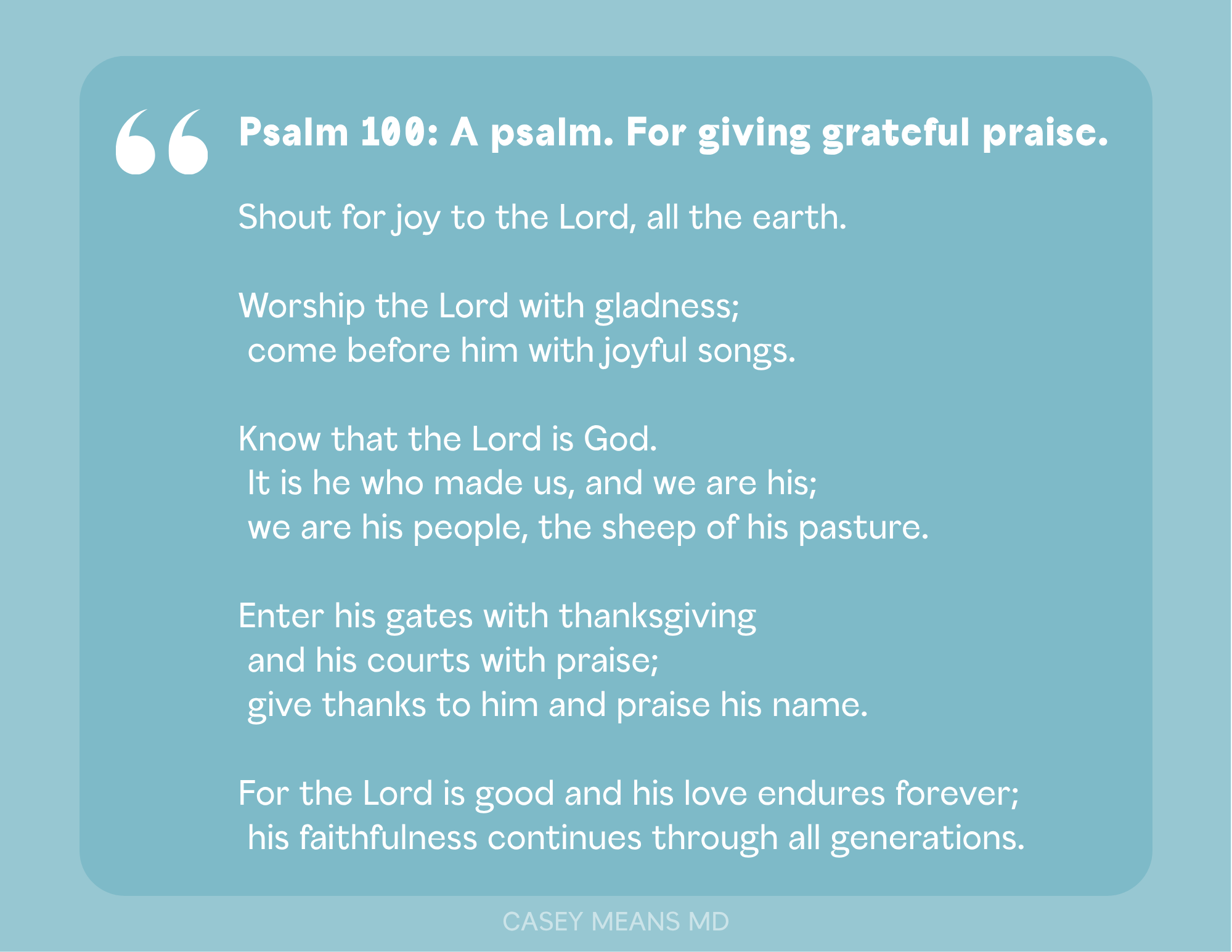
I was floored. Here I was, spinning in my mind about an unknowable future instead of honoring the gorgeous present moment in front of me. And suddenly, the cosmos gave me a little sign—a “wink from God,” as we call them in our family—of a possible path forward: Get out of the head, and into a heart of gratitude.
🤲 Gratitude as medicine for uncertainty
This landed especially powerfully for me because my mom—the most joyful person I’ve ever known, who faced her rapidly impending death with equanimity and peace—was a gratitude evangelist. She kept a gratitude journal every single night in a little robin’s-egg blue book, where she wrote about what she was grateful for that day.
In difficult times in my life, she counseled me to do the same. Once, after a breakup, when I was stuck and sad, she told me to just get a blank sheet of paper out and start writing down everything I was grateful for. Since nothing else was working to get me out of my funk, I started filling pages with endless things I was grateful for, big and small. Within a few days of this practice, I felt the world miraculously open up again like coming out of a dark tunnel. It was a non-obvious path to recover, but it worked.
And when push came to shove—when my mom received a terminal diagnosis of stage 4 pancreatic cancer and had only 13 days to live—she turned straight to gratitude, spending her final days in love, appreciation, and awe for the beautiful life she had lived and people she had loved. Just moments before she transitioned out of consciousness for the final time, she told us that life is “perfect and beautiful”... words that ring in my head all the time. Gratitude protected her from existential despair in her final days; that in and of itself shows it must be powerful medicine.
The nudge to read Psalm 100 and focus on gratitude was a sign that did not come in isolation, and I’ve come to believe that God will often give us multiple pings to solidify a message.
Just a few weeks earlier, when my husband and I were at a spiritual lecture at Lake Shrine in Los Angeles (founded by Paramahansa Yogananda, who brought Indian spiritual principles to the West), the sermon was verbatim to Psalm 100. In the temple that day, Brother Tyagananda shared that “gratitude opens up a portal.”
He reminded us that while we are often thankful for what we receive, we rarely stop to thank the giver. He reminded us that when we give someone meaningful gifts or help, and do not get thanks, it can hurt. He suggested that God perhaps “feels” the same way. “Don’t you love the giver more than what I have given?”
He said that many of us feel we are too busy to stop and give thanks to a higher power, but it simply is one of THE most powerful things we can do to stay in a state where blessings, synchronicities, and divine insights are abundant.
(Bringing this back to the AI theme: Steve Jobs–who is one of the early tech pioneers to predict AI–asked that a single item be given to every attendee at his funeral: a copy of Autobiography of a Yogi, the book written by Paramahansa Yogananda, who founded Lake Shrine. Jobs credits this book with helping teach him that his intuition was his greatest gift.)
💡 Remembering our most unique source of power
In a time where we are grappling with the idea of technological superintelligence, it is important for us to remember that there is a form of unfathomable intelligence within us that our modern, fast-paced culture often distracts us from cultivating: our spiritual nature.
We all have the hardwiring for it – Dr. Miller’s research shows this. Specifically, decades of peer-reviewed research suggest that spirituality is inborn in everyone, with neurocircuitry that is one-third innate and two-thirds cultivated through experiences—with stronger spiritual connection linked to lower rates of despair and higher levels of resilience, grit, optimism, and forgiveness. But it may require discipline to access it: slowing down, going inward, putting the phone away, and creating enough quiet to hear what wants to come to you. We don’t need to muster that discipline alone - we can ask God for help.
And don’t take my word for it—take it from Albert Einstein. This is a man who spent hours just staring out the window daydreaming, who received epiphanies that re-wrote the laws of the universe, and who was deeply focused on awe and gratitude:
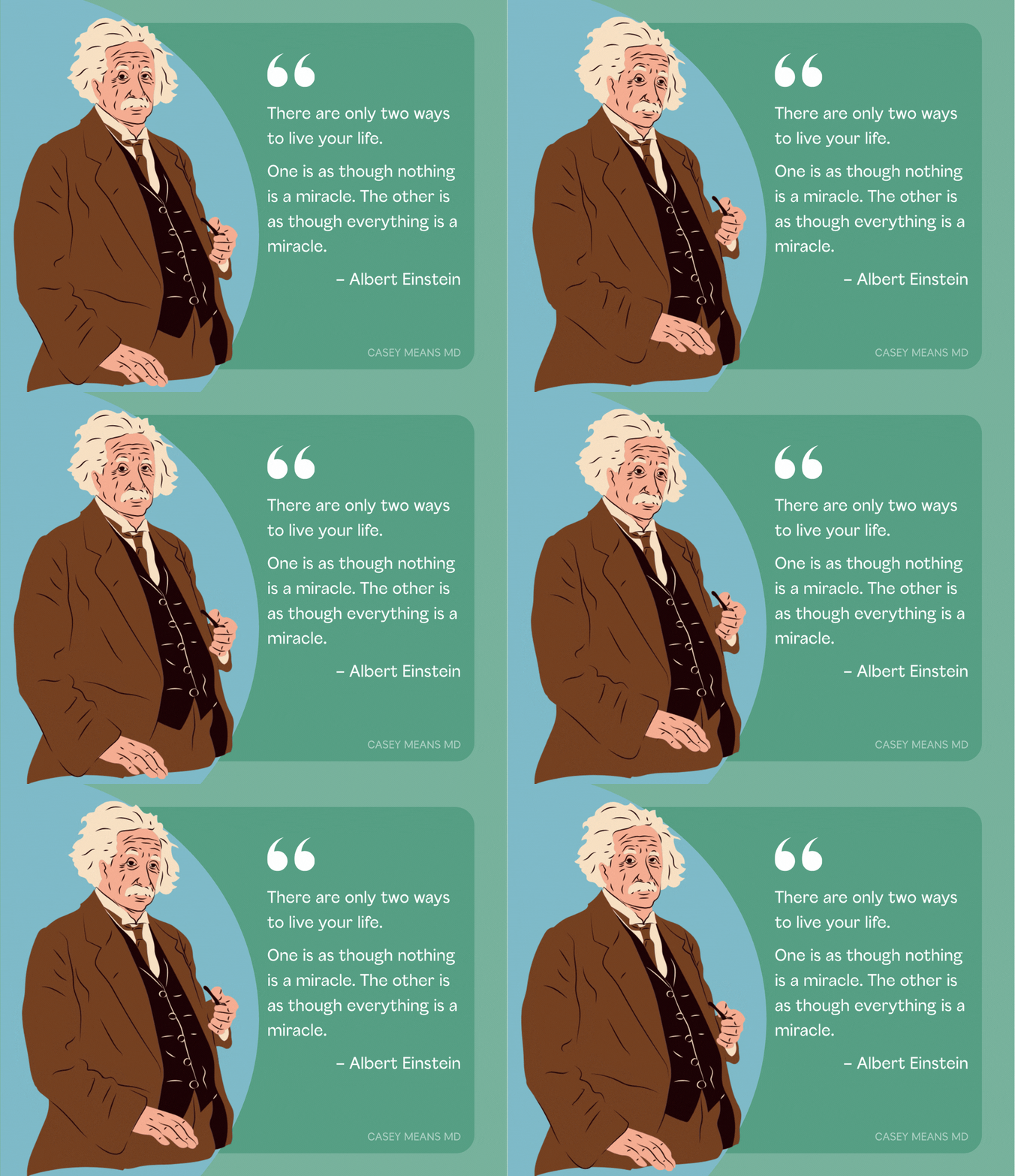
“There are only two ways to live your life,” Einstein said. “One is as though nothing is a miracle. The other is as though everything is a miracle.”
Here’s the model I’m thinking about today, based on the “winks from God” I had in the form of Psalm 100 and the Lake Shrine lecture:
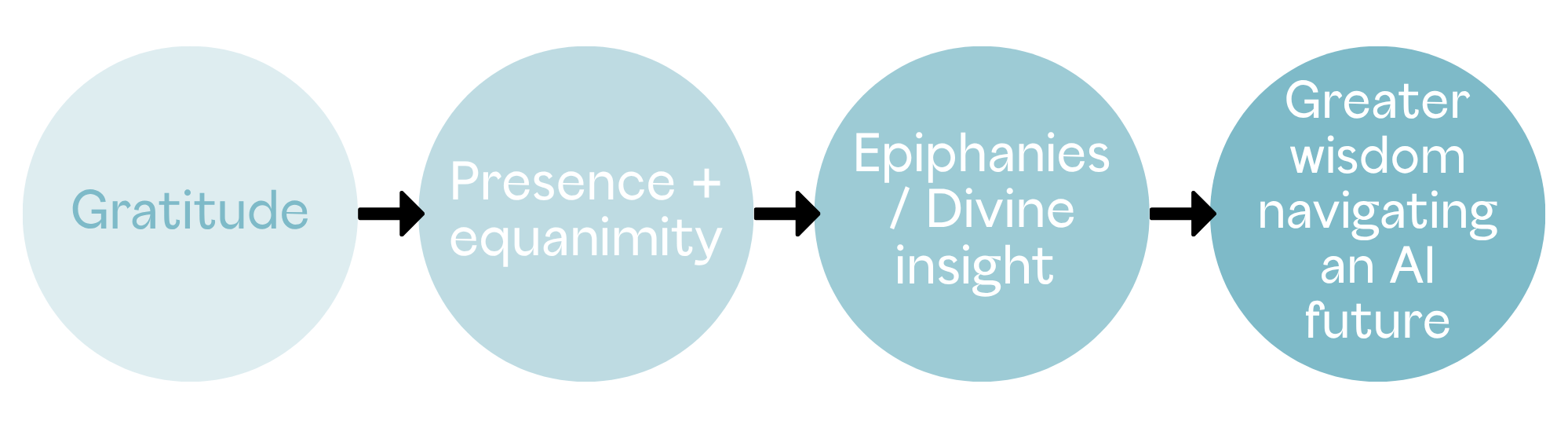
(And, in a third wink from God about this topic, Pope Leo XIV released his 42,000 word Magnifica Humanitas encyclical on how to protect human life and dignity in the time of AI on the same day I wrote this newsletter on a similar theme. I will dive more into the highlights from that document next week - it’s a useful analysis well worth reading.)
We probably can’t outthink superintelligence. But we can pray. We can express gratitude for the miracle of our lives and seek wisdom for how to navigate what’s ahead with integrity. We can radically lean into being more loving, we can fiercely nurture family and community, and we can commit to the long, difficult, disciplined work of developing wisdom and understanding rather than merely consuming information. Maybe that will be enough, if enough of us do it. Who’s to say it won’t?
💡 It’s also worth remembering that AI has been trained on vast amounts of human-created language and knowledge — and as such, it reflects the patterns of our species. If humanity’s informational environment became wiser, kinder, more thoughtful, and less driven by fear and division, future AI systems could likely reflect more of those patterns too. Which means that improving ourselves — our consciousness, our discourse, our reactivity, our communities, and what we project into the world — may be integral in shaping the future of AI.
🫀 Gratitude transforms our health
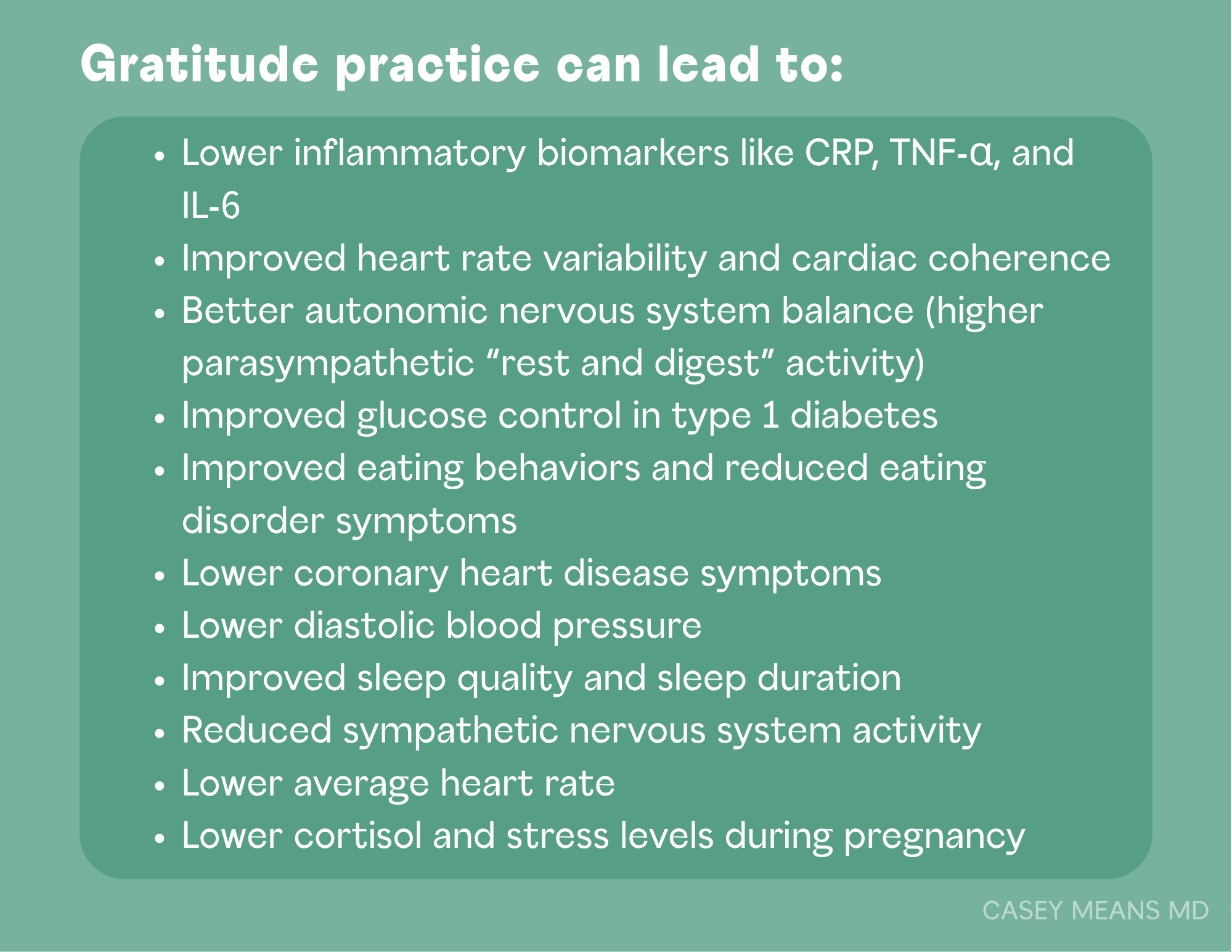
And for those of you here for the health tips, know that all of this is one: gratitude practice—in the form of gratitude journaling for as little as a few weeks—as well as cultivating a sense of awe–have been shown to significantly lower inflammatory markers, cardiovascular disease risk, mortality risk, improve sleep, lower depression scores, and even impact blood sugar. In these studies, the instructions for participants included prompts like, “for the next eight weeks you will be asked to record 3-5 things for which you are grateful on a daily basis. Think back over your day and include anything, however small or great, that was a source of gratitude that day. Make the list personal, and try to think of different things each day.” Pretty easy!
📆 What to do this week
A simple prescription for becoming more awake in the AI era: Tonight, before bed, write down three (or more!) things you’re grateful for — even tiny things. Your coffee. A text from a friend. The ability to simply breathe.
And, when you feel like you’ve been given a “wink from God,” write it down immediately and express gratitude for it. I think you’ll start seeing more of them when you do. (My wink of the day: Today, as I was getting ready to press “send” on this newsletter, my husband walked in the door holding a baby blue robin’s egg — the first he’s ever found on his walks — just after I wrote about my mom’s robin’s-egg blue gratitude journal 😉🩵).
Feel free to send me your reflections — I read all your responses!
With good energy,
Casey Means
Forward to a friend: If you enjoyed this issue, please forward to a friend! They can sign up for the newsletter here.